
Some presidents want a legacy. This one appears to want a replacement sign for every surface in the country. Now the Pentagon gets to sound tougher, which is excellent news for anyone planning to defend America with a business card.
Key takeaways
- The September 2025 order authorized Department of War as a secondary title and preserved statutory references until changed by law.
- CBO estimated implementation costs ranging from a few million dollars to $125 million, depending on the approach.
- Those are estimates, not proof that $125 million has already been spent.
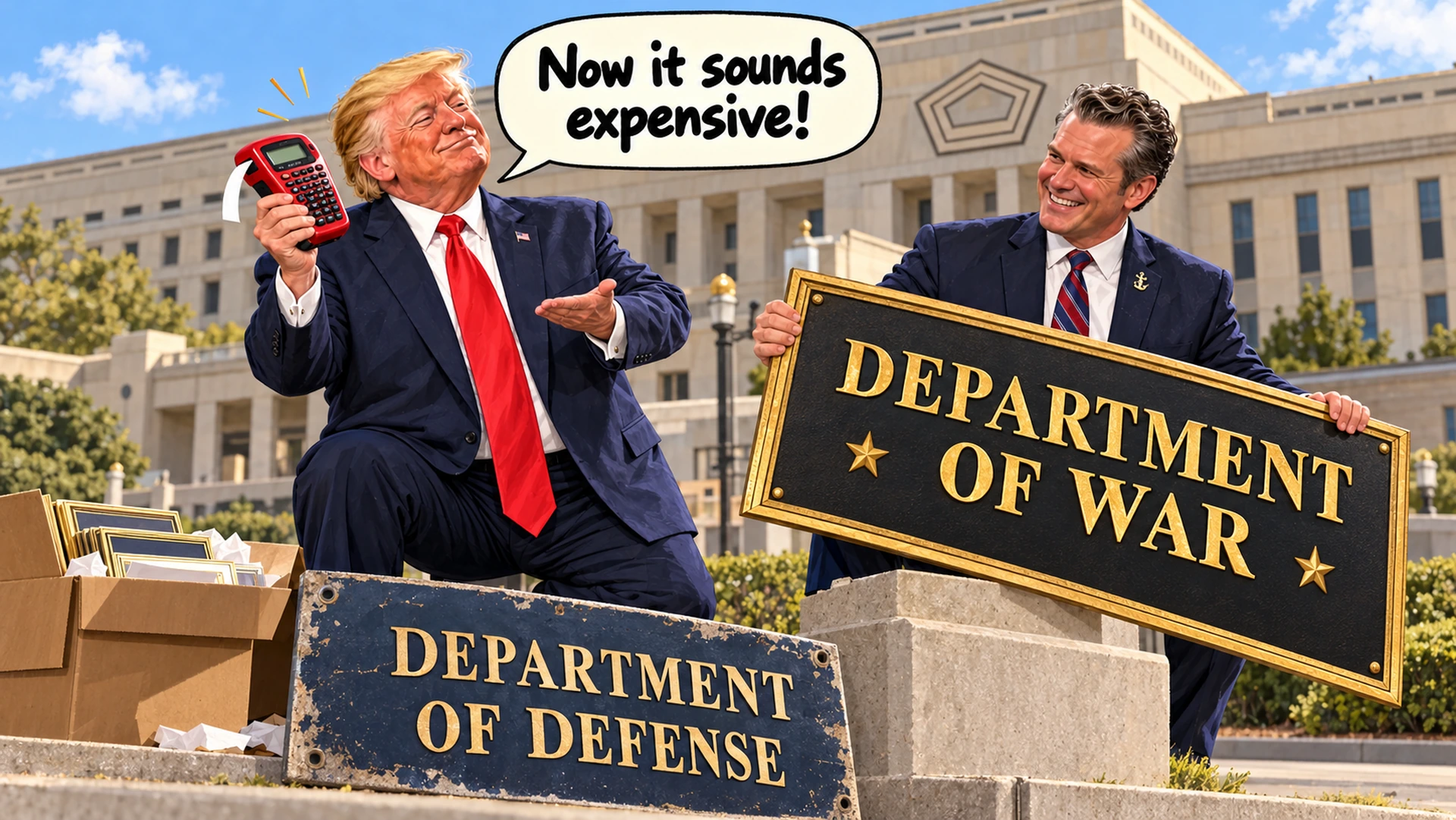
Our imaginary ribbon-cutting has Trump holding a label maker and Pete Hegseth admiring a gilt Department of War sign. The cardboard box contains stationery. The national-security breakthrough is still awaiting delivery.
Even the order knows a name has limits.
Read Executive Order 14347, dated September 5, 2025. It authorized secondary titles for official communications and ceremonial use. It also said statutory references to the Department of Defense and its officials would remain controlling until changed by law. The order itself did not rewrite those references.
That is a splendid little detail for a naming administration. Even its own document admits the legal work survives the new lettering. The label maker cannot repeal a statute. Somewhere, a disappointed gold engraver is asking whether the Constitution comes in removable vinyl.
The stationery has a price tag.
The Congressional Budget Office’s January 14, 2026, estimate put the cost of implementing the secondary name at a few million dollars for a minimal phase-in, roughly $10 million for a modest approach, or as much as $125 million for a broad, rapid rollout. A statutory renaming could cost hundreds of millions, depending on implementation.
CBO stressed uncertainty because the department had not supplied its implementation plan. These are possible costs under different choices, not an invoice showing $125 million already paid. For the modest option, CBO described costs that would probably come from existing budgets, displacing other activity. A budget does not become bottomless because the expense has a more aggressive noun.
A tougher noun does not fix a roof.
Imagine explaining a deferred repair to a service member’s family while the boss proudly points at the replacement sign. That is an invented example, not an allegation about a particular base. It illustrates the ordinary question behind an opportunity cost: what else could the time and money have done?
A public agency can change its branding. It should still explain the benefit. Does the new title improve training, equipment, readiness, or the care of military families? If the answer is that it makes the secretary sound more fearsome, perhaps the secretary could buy his own novelty desk plaque.
Hegseth gets a starring role in this cartoon because somebody has to hold the sign while the president takes credit for discovering the word war. The troops did not ask to become extras in the national office-supply commercial.
The naming spree has found another uniform.
The broader habit is documented in Name Games: announce a preferred term, expect everyone to repeat it, and treat compliance as evidence that something important happened. The new vocabulary becomes the accomplishment. Anybody asking what improved risks interrupting the photograph.
And now Project Meridian brings Musk and company back into the picture. There may be serious technology to examine. There will certainly be serious claims to check. Neither deserves to be judged by the quality of the new stationery.
Our contribution to the vocabulary is Department of Prove It. Same public money. Much less ceremonial bullshit.
Questions for the Department of Prove It
Did the 2025 order itself change the statutory name?
It authorized a secondary title and expressly kept statutory references controlling until changed by law. That distinction is in the order’s implementation section.
Has the rebrand definitely cost $125 million?
That is not what the cited CBO report says. It gives a range of possible implementation costs; $125 million is the upper estimate for a broad, rapid rollout of the secondary name.
Are the sign ceremony and dialogue real?
No. Our illustration is an invented political cartoon. The order and CBO estimate are real, and the links let you check them.