Donald Trump has a wonderfully efficient system for handling bad news: declare it fake, insult whoever delivered it, and resume congratulating himself. The rest of us have been doing this all wrong. We keep opening bills, checking our balances, and assuming the numbers require attention. Apparently, we should have been yelling at the envelope.
Key Takeaways
- On October 19, Trump called the affordability debate a "Fake News CON JOB!" while claiming credit for bringing prices down.
- A Reuters/Ipsos poll released the same day put his job approval at 31%. His earlier dismissal of low polling as "fake numbers" is documented in TIME's September 28 interview.
- A poll can be challenged with evidence. A household bill remains payable after a presidential tantrum.
An economic plan with one button
In his October 19 Truth Social post, Trump blamed Democrats for the affordability crisis, credited himself with a great economy, and dismissed the issue as a "Fake News CON JOB!" The archived post records the statement at 3:05 p.m. Eastern.
There it is: economic relief through punctuation. Somewhere, a family weighing groceries against the electric bill can relax. Their problem has been downgraded from financial hardship to insufficient enthusiasm.
Try taking that approach to the gas station. Explain that the total is a politically motivated attack on your otherwise magnificent afternoon. Demand that the pump apologize. If the attendant remains unmoved, accuse the little screen of working for CNN.
You will still owe for the gas. You may also be asked to leave before you investigate the ideological leanings of the hot-dog roller.
The stupidity here is spectacularly practical. People need money to stretch further. Donald offers them a different word for the problem, then expects applause for the savings. It is like a plumber announcing that the water pouring through your ceiling is biased reporting.
The pollsters forgot to allow for flattery
Reuters reported on October 19 that its latest Ipsos survey put Trump's approval at 31%. Among registered voters, 47% chose Democrats and 35% Republicans on the generic congressional ballot. Ipsos says the survey ran October 16-19 and included 1,679 adults.
Those are national survey results, with uncertainty. They do not settle individual races or guarantee who will control Congress. A serious discussion examines the sample, questions, weighting, and other polls.
Donald has previously proposed a considerably less demanding review process. In his September 28 interview with TIME, published October 1, he responded to a question about low approval by saying, "They're fake numbers." His own assessment: "See, I'm doing very well. I think I am."
Beautiful. The independent evaluation has been referred to the man being evaluated, who has cleared himself of disappointing anyone.
A poll can have a margin of error. Donald appears to be requesting a margin of flattery. Somewhere between the weighted sample and publication, someone was supposed to add enough imaginary admirers to make the boss feel handsome.
For a man who loves numbers when they flatter him, he gets remarkably upset when they count everybody else.
The government help desk for hurt feelings
This habit predates the October 19 affordability rant. In an August 30 post attacking polls, Trump appealed to the Federal Communications Commission: "FCC TO THE RESCUE!"
Imagine being the employee who takes that call. The president is displeased with a percentage. Has anyone tried a different percentage? Have we checked whether the respondents were aware they were supposed to be grateful?
In our entirely imaginary troubleshooting manual, the first step is to unplug the television. The second is to plug it back in somewhere that carries only compliments. If the problem persists, promote the remote control to communications director.
There is something exhausting about a president who keeps treating public feedback as a defective product. The customer-service department cannot replace the country with a more agreeable one. Eventually, someone has to deal with the complaint.
Our Enablers department should consider offering a new service: stand beside Donald and nod while he explains that the thermometer is responsible for the fever.
Please accept my payment in denial
Ordinary people should at least be allowed to test this marvelous system. Your credit-card balance is fake. The late fee is a hoax. That disappointing performance review was prepared by radical colleagues who refuse to acknowledge your historic achievements near the coffee machine.
If your landlord objects, explain that you are enjoying the greatest apartment economy in history. Show him a photograph of a crowd that once liked you. This should resolve the matter, provided your landlord accepts payment in self-esteem.
That is the problem with selling denial as relief: the people hearing it still have to live in the world afterward. The shopping, the commute, and the monthly arithmetic continue after Donald finishes posting.
He gets to feel vindicated. They get to put something back on the shelf.
A correction requires more work than a nickname
News reports can be wrong. Polls can miss. A responsible challenge identifies the error and supplies something checkable in its place. The Receipts page exists because evidence is more useful than the volume at which someone announces his innocence of ever being mistaken.
The president could explain which affordability claims he disputes, show the relevant figures, and describe what he will do about the costs people face. That would give everyone something to examine besides his mood.
Instead, we get the political equivalent of a man losing at Scrabble and declaring the dictionary corrupt. The board remains on the table. The letters remain where he put them. His opponents are apparently supposed to apologize for knowing a word.
Call the coverage fake. Call the poll fake. Keep going until every unpleasant fact has a little red label and the entire briefing consists of people congratulating you on the labels.
Then try paying the grocery bill with one.
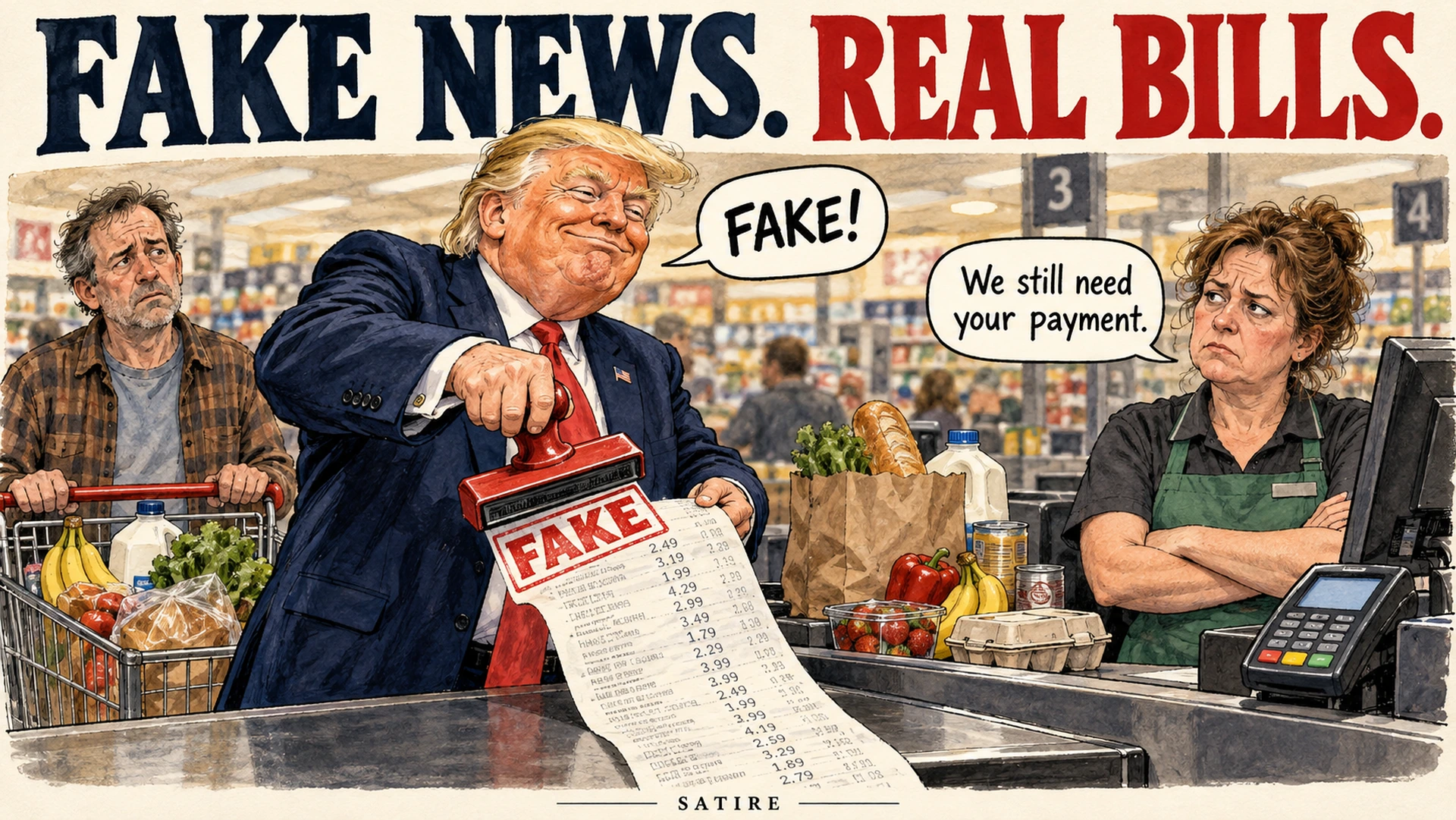
Fake news. Real bills. The cashier doesn't give a damn about your approval rating.
Questions worth asking
What did Trump say on October 19?
He blamed Democrats for the affordability crisis, claimed he was bringing prices down, and called the issue a "Fake News CON JOB!" The archived Truth Social post is dated October 19, 2026, at 3:05 p.m. Eastern.
Did he call this specific October 19 Reuters/Ipsos poll fake?
The sources used here do not establish that. The article distinguishes the October 19 survey from his documented September 28 remarks dismissing low polling, and his August 30 attack on polls.
Does a national poll tell us who will win every race?
No. Approval ratings and generic congressional ballot results measure national sentiment. Individual contests depend on their candidates, electorate, turnout, and other conditions; survey results also carry uncertainty.
Did the grocery-store scene happen?
No. The cartoon, its dialogue, the help-desk scenario, and the everyday comparisons are invented satire. The dated statements and poll findings are separately sourced.
Receipts
- Trump's October 19, 2026, affordability post, archived by Trump's Truth. Original Truth Social post.
- Reuters, October 19, 2026: Trump's approval falls to 31% in Reuters/Ipsos polling.
- Ipsos: October 16-19, 2026, survey methodology.
- TIME: September 28, 2026, interview transcript, published October 1.
- Trump's August 30, 2026, polls/FCC post, archived by Trump's Truth.
Political satire and opinion. Real statements are attributed and dated. The cartoon and imagined scenarios are fictional.