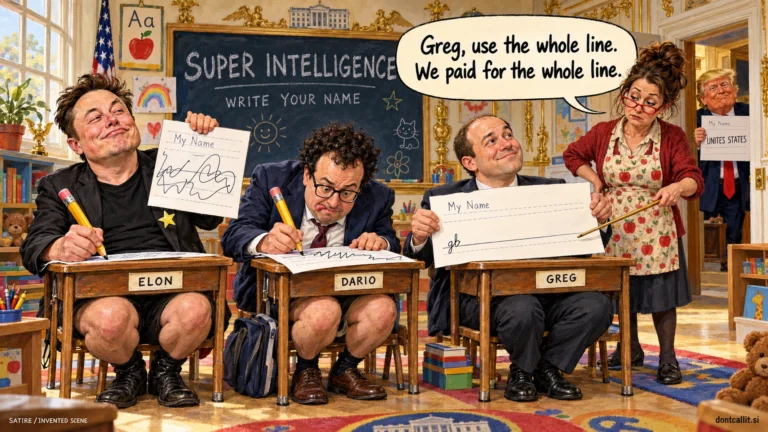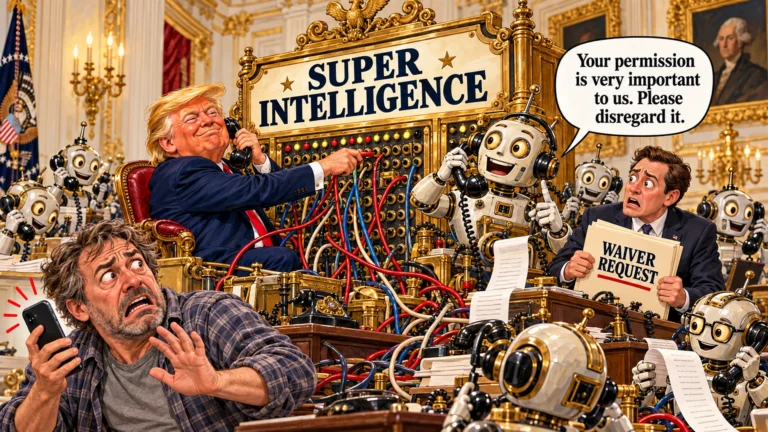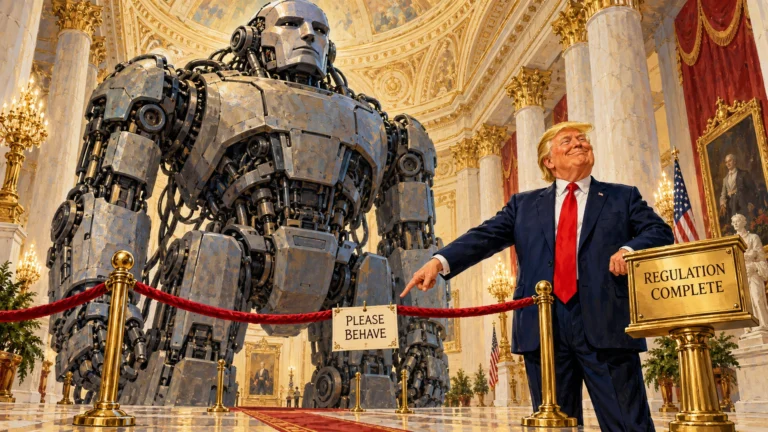
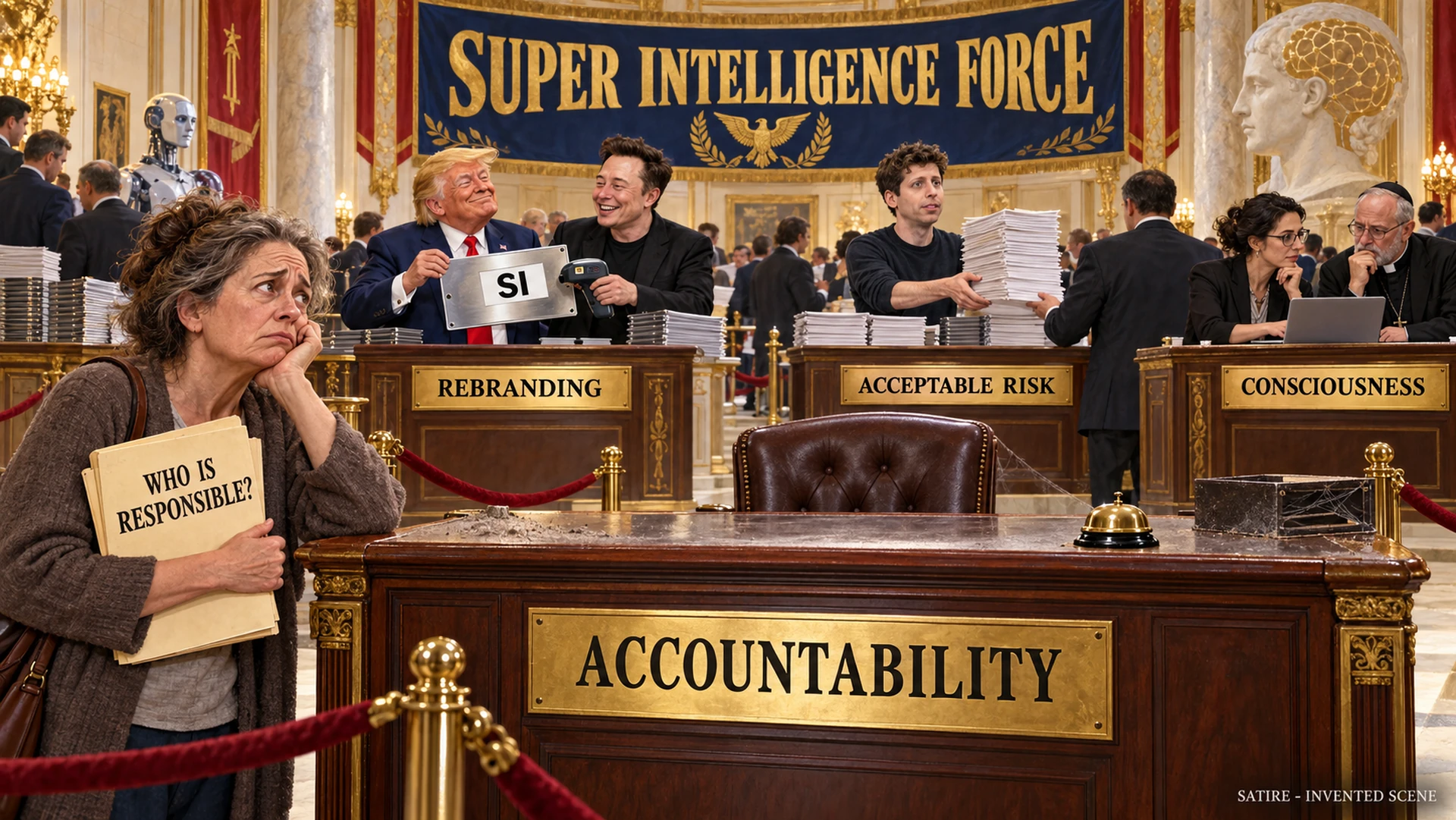
Washington has given its AI push a magnificent new name. Silicon Valley is arguing about safety, acceptable harm, and whether its products might deserve moral consideration. Somewhere in this spectacular display of confidence, a basic question is standing outside the meeting room: who answers to the people using this stuff? We appear to have room for a Force, a rebrand, and a discussion about machine consciousness. Could someone squeeze accountability onto the agenda?
First, assemble the stationery
On October 4, Trump announced the Super Intelligence Force, a federal coordinating task force reporting to him and Chief of Staff Susie Wiles. Source: Trump's announcement, archived by Trump's Truth.
We already covered the capes-first approach. This installment concerns the person who should be checking whether the cape has become caught in the machinery.
At our imaginary task-force meeting, the first action item is to find an action item worthy of the letterhead. A staffer proposes testing something. The chair asks whether the test can wait until after the launch. The photographer needs everybody looking confident while the equipment is still off.
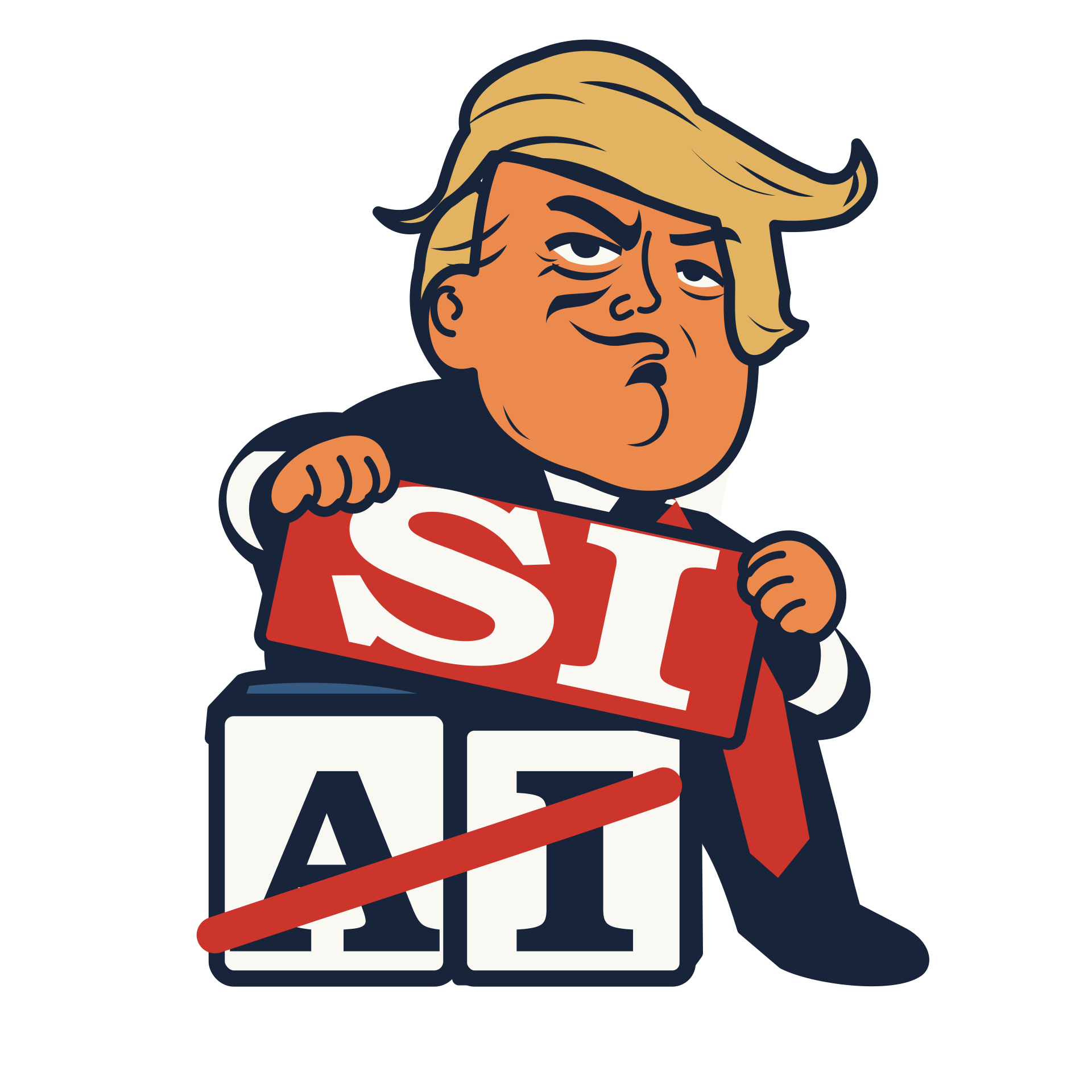
On the same day, Musk said he would rename SpaceXAI to SpaceXSI. Reuters reported that the account name had not yet changed and that no timeline had been supplied. Source: Reuters.
So, a proposed rename. The source gives us no basis for the claim that he completed it within five minutes.
Our label-maker department is thrilled. Changing a letter is a wonderfully manageable project. Explaining what the system can reliably do takes considerably more effort.
The man writing the safety reports leaves
David Robinson, who led OpenAI's safety-report writing, resigned and published an October 3 essay titled "I Quit OpenAI Because Its Culture Is Broken." His criticism centered on the company's culture and its reliance on learning from failures as systems grow more capable. Sources: Robinson's essay and Reuters.
His role matters. Describing him as the company's overall safety chief would exaggerate it. Describing the departure of someone responsible for explaining safety as uninteresting would be a remarkable act of optimism.
Imagine a restaurant where the person writing the food-safety report leaves and explains that the kitchen's culture worries him. You might still enjoy the menu. You would probably have a few questions about the kitchen.
OpenAI says it is strengthening safety and security, and pauses training or withholds models when needed. Source: OpenAI's response reported by The Guardian.
Back in our fictional safety demonstration, the emergency stop button is mounted behind the person giving the presentation. An observer asks to test it. The presenter says that would stop the presentation. The room agrees that safety should remain constructive.
Benefits for everybody. The bill goes where?
Reporting on Altman's October 5 Politico interview describes his argument for broad access and accepting "some bad things happening" for AI's benefits. He also rejected accepting "really catastrophic risks," including serious loss of control. That qualification belongs in the story. Source: Benzinga's account of the interview.
There is a reasonable debate about access, innovation, and regulation. Every useful technology involves tradeoffs.
The awkward bit is deciding who gets to make the trade and who receives the invoice.
In our invented product demonstration, an executive announces that the benefits outweigh the risks. A user asks which side of the scales they are on. The executive consults a slide, discovers they are under "acceptable harm," and asks whether they would mind standing farther from the camera.
"A net benefit to society" is a fine discussion topic. It becomes less comforting when you suspect you have been assigned to the subtraction column.
That is why our velvet-rope safety department keeps asking about inspection and enforcement. A promise needs a way to establish whether it was kept.
The Vatican gets a meeting request
A September 29 New York Times report, republished by The Philadelphia Inquirer, described Anthropic's religious consultations. At a May Vatican visit, cofounder Christopher Olah and colleagues reportedly urged the pope's advisers to take possible AI consciousness seriously. Olah also acknowledged commercial incentives and urged outside accountability. Source: Elizabeth Dias's reporting.
That is more specific than "Anthropic asked the Pope whether Claude has a soul." The reporting does not establish that exact exchange.
Anthropic's own constitution states uncertainty about AI consciousness and moral status. It does not establish that Claude has a soul. Source: Anthropic's constitution.
Religious scholars can contribute to serious ethical questions. Consulting them is reasonable. Machines' possible moral status is a subject people can investigate without settling it through a punch line.
But while that conversation proceeds, the humans already involved need answers about consent, privacy, remedies, and control. Those questions do not require a breakthrough in theology.
In our imagined Silicon Valley reception area, "Does the product have a soul?" gets a beautifully embossed visitor badge. "Who is responsible if it hurts someone?" is still being transferred between extensions.
Please put a human in charge of the human consequences
This site is built with AI. We use it because it can be useful, funny, and productive. That experience gives us plenty of reasons to care about whether it works responsibly.
In our fictional office plan, accountability has been assigned the desk nearest the fire exit. Its computer has no permissions, its phone goes to investor relations, and its STOP stamp has been replaced with a REQUEST ANOTHER MEETING stamp. Management calls this a seat at the table.
Those are choices governments and companies can make now. Nobody needs to resolve machine consciousness before publishing a clear complaints process.
Trump can announce the Force. Musk can change the lettering. The labs can argue about benefits and consult philosophers, clergy, and researchers.
Somewhere in all that excitement, please give accountability a desk, a budget, and the authority to say stop.
The name says super. Show us the work.
Key Takeaways
- Trump announced a federal Super Intelligence Force. A government's choice of name tells us nothing about a machine's capabilities.
- Musk announced a planned rename, while an OpenAI safety-report writer resigned and Altman defended accepting some harms for AI's benefits.
- Anthropic's reported Vatican discussions concerned consciousness and moral status. The urgent public question remains who can inspect, challenge, and stop unsafe deployments.
Frequently Asked Questions
Does the Super Intelligence Force announcement prove superintelligent AI exists?
No. It announces a government coordinating body. A label supplies no evidence of a system's actual capabilities.
Had the SpaceXSI rename been completed when Reuters reported it?
Reuters described Musk's plan and said the account name had not changed at publication. Completion was not confirmed in that report.
Did Anthropic prove that Claude is conscious or has a soul?
No such proof is established by these sources. The reported discussions and Anthropic's stated uncertainty leave those questions open.
Is this an argument against using AI?
It is an argument for asking who is accountable when AI is used. Useful tools still need evidence, oversight, and a way to address failures.
Receipts
Research checked October 6, 2026. Announcements, reported claims, company responses, and editorial judgments are distinguished above. The cartoon is an invented reception-hall scene, not an actual meeting.