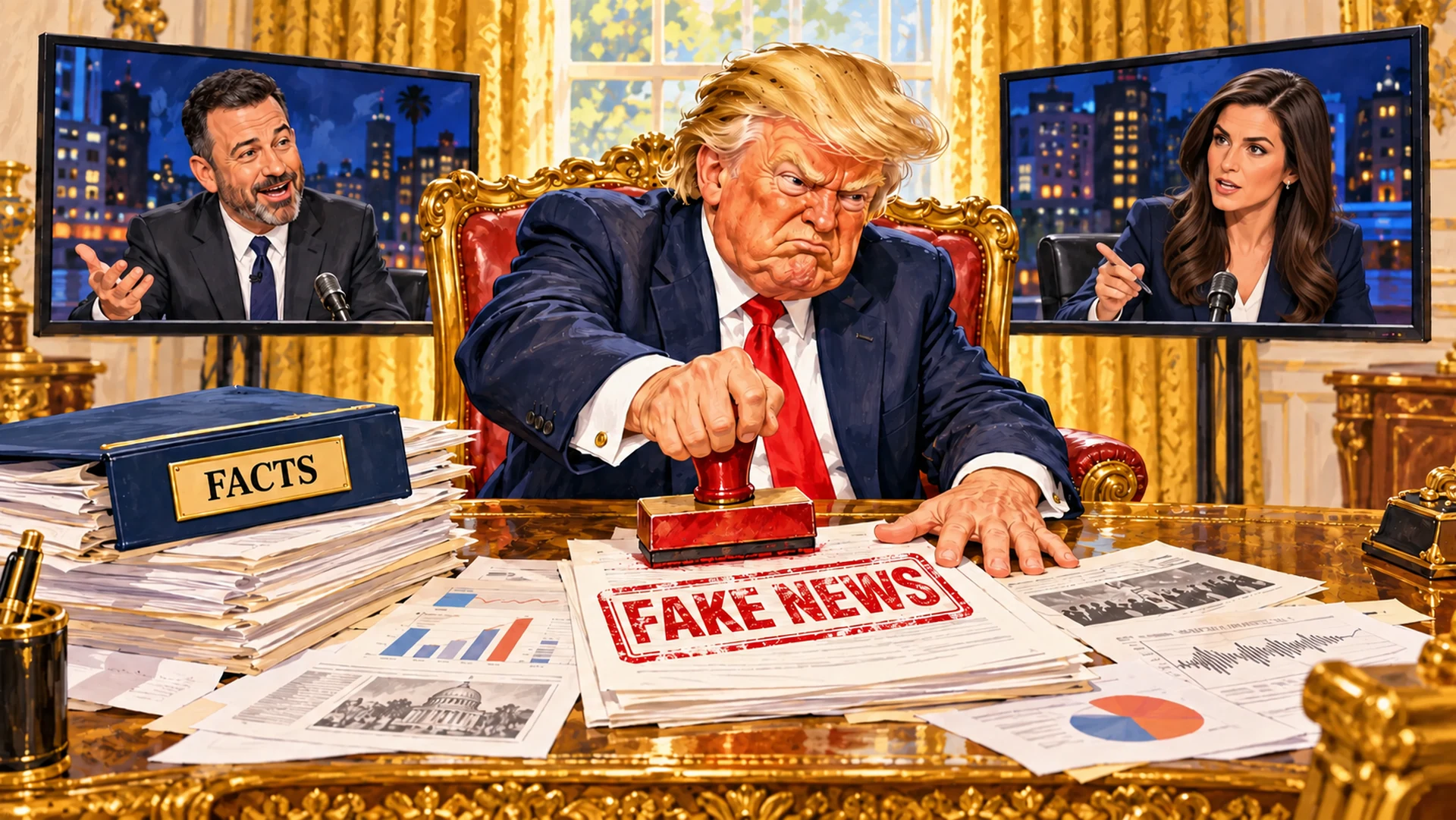
A story embarrasses him. A comedian mocks him. A reporter asks the question he wanted left unasked. Out comes the same red stamp: FAKE NEWS. Trumpet Baby has invented an astonishingly convenient quality-control system. The facts pass inspection when they flatter the inspector.
Two words, zero rebuttal.
There is a perfectly reasonable way to challenge a news story: identify the statement, produce the contrary evidence, and ask for a correction. You can question a source, expose a misleading edit, or distinguish an allegation from a finding. None of that requires worshipping a newsroom.
The nonsense starts when "fake" becomes a synonym for unwelcome. If the article contains an authentic recording, calling the reporter a loser does not change the recording. If it accurately describes a court finding, insulting the newspaper does not reverse the finding. Reality is remarkably poor at taking orders from a man with a social-media account.
There is another trick inside the label: it collapses reporting, commentary, and comedy into one alleged conspiracy. A joke can be cruel or unfunny without being a fabricated news report. A skeptical question can be irritating without being false. Apparently the presidential thesaurus has one entry under "things I hate."
Lesley Stahl described the purpose years ago.
In a public discussion in 2018, Lesley Stahl recounted an off-camera conversation with Trump before the 2016 election. TheWrap's report and video describe her account of asking why he kept attacking the press. She said he explained that he wanted to discredit journalists "so when you write negative stories about me no one will believe you."
That is Stahl's account of his words, not an independently recorded confession by Trump. The distinction belongs in the receipt. Her account nevertheless describes precisely the strategy worth examining: damage the messenger's credibility before the unfavorable story arrives.
Think of the red stamp as advance customer service for the next scandal. The audience is offered a ready answer before it examines the documents. Conveniently, the person under scrutiny also appoints himself the only trustworthy source about the scrutiny. Even the gold-plated suggestion box has a shredder attached.
Kaitlan Collins, "stupid," and "piggy": insults are not answers.
Kaitlan Collins is a useful example because the attacks reach beyond a particular disputed sentence. On September 8, 2026, Trump called CNN's chief White House correspondent "very dumb and unhappy" and described a panel on her show as "FICTION AND LIES." Mediaite reproduced the post and CNN's response. The network defended her reporting; Trump's post did not lay out a specific factual correction.
The CNN transcript from June 3, 2026 records him attacking Collins's expression and appearance, saying she "never smiles" and had "hatred in her eyes." On September 22 at the United Nations, after CNN's White House ban, he told her, "You should not be here covering me." The transcript preserves her response that the UN had admitted the journalists. A reporter's smile is not evidence that her reporting is wrong. Neither is the president's wish that she leave.
The insults have other named recipients. On November 27, 2025, CBS's Nancy Cordes challenged his account of Afghan vetting and asked why he blamed the Biden administration. CNN's next-day transcript of the recorded exchange preserves his response: "Are you stupid? Are you a stupid person?" If he had evidence that contradicted the premise, he could present it. A verdict on the questioner's intelligence is not that evidence.
On November 14, 2025, Bloomberg's Catherine Lucey pressed him about the Epstein files aboard Air Force One. He interrupted with "Quiet, quiet, piggy." Lead Stories identifies Lucey and links the recording. The insult was aimed at Lucey, not Collins. Keep the people straight: the pattern is ugly enough without assigning everyone else's abuse to the woman in our cartoon.
The White House defended the remark on November 20. Karoline Leavitt characterized Trump as frank and accessible and said he called out fake news; Reuters noted she supplied no evidence of false information in that exchange. That defense turns the insult into a supposed reporting correction without showing what was incorrect.
In our fictional press briefing, the president has brought a chart of approved facial expressions. Beaming is patriotic. Concerned is hostile. Any face that accompanies a follow-up question requires further vetting. A reporter asks whether the chart corrects her story. Donald says she is making that face again.
"Fake" can become a team jersey.
A 2020 study by Sander van der Linden, Costas Panagopoulos, and Jon Roozenbeek examined a survey of 1,000 U.S. respondents. People's associations with "fake news" tracked political preferences: liberals and conservatives tended to attach the label to opposing outlets, and conservatives were more likely to associate it with mainstream media. Those associations also related to lower media trust.
This was survey research, not an experiment proving that Trump caused distrust. It does help explain the concern: a supposedly factual label can function as a signal of whose side you are on.
At our invented newsstand, the customer asks whether a report is true. The clerk asks which team he supports. The customer asks whether the clerk has read it. The clerk says that would complicate the recommendation. The sports pages are beginning to feel underqualified.
Kimmel: the regulator entered the punchline.
Jimmy Kimmel's September 2025 suspension was not merely a president complaining about a joke. Reuters documented FCC chair Brendan Carr's warning to broadcasters after Kimmel's remarks about Charlie Kirk's killing: "We can do this the easy way or the hard way." ABC suspended the show on September 17. Kimmel returned on September 23, after six days.
The other side of the record matters. Carr denied that government action caused the suspension and pointed to ratings; Disney said it had sought to de-escalate a tense situation. Republican Senator Ted Cruz also criticized Carr's approach. You do not have to endorse Kimmel's remark to object to a federal regulator introducing consequences into a programming dispute.
The pressure did not end with that episode. An FCC public notice records an April 28, 2026, order requiring early renewal applications for eight ABC-owned television stations. Their ordinary renewals were not due before 2028. In August, ABC sued, alleging retaliation for protected speech; the FCC said it was investigating unlawful DEI practices and enforcing stations' public-interest obligations. That is a contested case, not a completed court finding that every agency action was retaliatory.
Then, in September 2026, Kimmel said an interview with Texas Senate candidate James Talarico would appear on YouTube rather than television because of FCC threats. AP reported his account and noted that the FCC did not immediately respond. A guest booking is not a fact-check failure. The objection concerns who gets heard.
Our view: when a regulator's warning hangs over a joke, a network does not need a formal censorship order to start calculating the price of the next punchline. The imaginary broadcast standard becomes: sufficiently amusing, provided the man with the stamp does not sulk.
Colbert: suspicious timing still needs honest wording.
On July 17, 2025, CBS announced that The Late Show with Stephen Colbert would end in May 2026. It called the move "purely a financial decision" and denied a connection to the show's content or other Paramount matters. Reuters reported that explanation alongside Trump's celebration the next day: "I absolutely love that Colbert got fired."
The corporate context deserves attention. Earlier that July, Paramount agreed to a $16 million settlement of Trump's lawsuit over a 60 Minutes interview. The FCC approved the Paramount-Skydance transaction on July 24, days after the cancellation announcement. Reuters's May 22, 2026, report also records Trump celebrating Colbert's departure and calling for Disney to fire Kimmel and Comcast to fire Seth Meyers.
A company needing federal approval while settling litigation with the president presents an obvious question about independence. It does not establish, by itself, that Trump secretly ordered Colbert's cancellation or that the settlement was an illegal bribe. CBS's denial belongs in the article; so does the sequence of events.
The criticism can stand on what is documented: a president publicly delights in a critic losing his platform and urges more companies to remove critics. That is a miserable attitude toward a free public conversation, even without inventing a smoking-gun memo.
AP, CNN, MS NOW, and Politico: access as an obedience test.
In February 2025, the Associated Press kept "Gulf of Mexico" in its style while acknowledging Trump's federal renaming. Its international audience was part of the explanation. Trump restricted AP access to presidential events and explicitly tied a change to the outlet adopting "Gulf of America," according to AP's February 18 report. This was an editorial naming dispute, not proof that the sea had been fabricated by journalists.
Fast-forward to September 18, 2026: Trump announced a White House ban on CNN, MS NOW, and Politico. On September 24, Judge Timothy Kelly temporarily ordered their press credentials restored for 14 days. Reuters reported that the outlets were likely to succeed on their due-process claim; the ruling was preliminary, not a final resolution of the lawsuit. The administration invoked national security, an explanation the judge found unsupported on the record then before him.
On September 28, the outlets asked for longer protection and alleged inconsistent implementation of the temporary order, including restrictions on CNN's pool participation. Those were the plaintiffs' allegations, not a new contempt finding. The dispute remained active when these receipts were checked on October 5.
Back at our fictional press-room nightclub, the reporter shows a press pass. The bouncer asks to see a recent compliment. The reporter says she covers the government. The bouncer checks his list. Apparently that is the problem.
A broadcast license is not a certificate of presidential happiness.
In July 2026, Trump attacked ABC and NBC after they did not carry a political speech. Reuters reported his demand: "Fraud like this should mean a revocation of their licenses." That transforms a scheduling choice into an accusation of fraud without supplying the missing factual argument.
The mechanics matter. FCC guidance distinguishes local licensed stations from national networks; there is no single magic "ABC license" that the president can tear up because a monologue annoyed him. 47 U.S.C. § 326 expressly limits FCC censorship and interference with broadcast speech. Stations still have legal obligations. Presidential irritation is not an obligation to flatter.
A regulator can investigate within its lawful authority. The objection here is using the language of licensing as a club in a personal argument. If the alleged problem is a false statement, identify it. If the alleged problem is that a network did not broadcast enough Donald, the complaint belongs with the imaginary Department of Applause.
A billion-dollar demand is not a billion-dollar receipt.
The Wall Street Journal's Epstein birthday-letter story led to Trump's $10 billion defamation suit. Trump denies writing the letter. The court's amended dismissal order explains that his original complaint failed to plausibly allege actual malice and allowed amendment. It expressly declined to decide the story's truth or the letter's authorship. Reuters reported his refiling on May 28, 2026.
Actual malice in this context concerns knowing falsity or reckless disregard for truth, not simply hostility toward a public figure. The court explained that Trump's denial alone did not establish the required showing. A dismissal at that stage did not authenticate the letter either. Anyone claiming the ruling conclusively proved it real or fake is adding a finding the judge did not make.
Trump also demanded $15 billion in his 2025 suit against The New York Times, Penguin Random House, and authors. The court record collected by the Civil Rights Litigation Clearinghouse shows his first complaint was struck for pleading defects in September; he filed an amended complaint in October. That procedural history is not a final verdict on the publications' accuracy.
The larger principle is dull, which is probably why it needs saying: an allegation in a complaint is an allegation. A huge requested payout is a requested payout. Neither becomes evidence merely because there are enough zeroes to fill the gilded desk. For the wider Epstein record, see the dedicated section of our Trump receipts article.
Yes, newsrooms can get things wrong. That is why specificity matters.
ABC provides a concrete example. In December 2024, it agreed to pay $15 million toward Trump's presidential library to settle a defamation dispute over George Stephanopoulos's description of the E. Jean Carroll jury finding. AP's report via PBS explains that the jury had found sexual abuse under the applicable New York law, rather than the statutory rape finding the broadcast described. ABC published a statement of regret.
A specific disputed claim, a specific settlement, and a specific correction can be examined. That does not make every ABC report false, reverse the underlying sexual-abuse finding, or establish that every presidential grievance is justified. Accountability works claim by claim. The blanket stamp dodges that work.
The same obligation applies here. We distinguish quotations from someone's recollection, a company's explanation from our suspicion, allegations from findings, and a comic premise from an actual event. The receipts are there to be opened, not admired as decorations.
The stupid part is the proposed test for truth.
If "fake" means anything the president dislikes, it cannot reliably distinguish truth from fiction. A genuine error and a thoroughly documented embarrassment get the same sticker. The audience is left with one question: does this help our guy?
The dangerous part is what can follow the sticker: demands to fire critics, restrictions on reporters, regulatory threats, and costly litigation. Each episode needs its own evidence and explanation. Taken together, the documented examples show why a two-word insult deserves more scrutiny than a shrug.
Nobody owes a journalist automatic belief. Nobody owes a president automatic disbelief either. Ask what the record supports. Check the quotation, the document, the correction, and the court's actual words. A free press earns trust through that work; a free public retains the right to do it.
Trumpet Baby can buy another stamp. The facts still do not owe him a kiss.
Key takeaways
- Calling coverage "fake" does not identify a false claim. A factual rebuttal needs evidence; a demand for flattering coverage needs obedience.
- Kimmel's suspension, ABC's early station-license reviews, newsroom access restrictions, and Trump's calls to fire hosts have documented records. The explanations and legal disputes matter too.
- CBS described Colbert's cancellation as financial. Its timing deserves scrutiny, but the record cited here does not establish that Trump directly ordered it. A lawsuit or settlement also does not automatically prove a story false.
Questions before the applause
Does unfavorable coverage automatically count as fake news?
No. Criticism, unwelcome facts, opinion, and satire are different from fabricated reporting. To challenge a factual claim, identify it and show the contrary evidence.
Was Jimmy Kimmel permanently fired in September 2025?
No. ABC suspended his show on September 17, and he returned on September 23. The later license dispute and his September 2026 account of an interview being moved online are separate episodes.
Did Trump directly order CBS to cancel Colbert?
That is not established by the record cited here. CBS described the cancellation as financial and denied a connection to content or other Paramount matters. Trump's public celebration and the corporate timing are documented.
Does filing a defamation suit prove a story false?
No. A complaint states claims for a court to consider. A settlement or a procedural ruling also does not automatically resolve every factual dispute; read the terms and the court's specific findings.
Receipts
Checked October 5, 2026. This article combines sourced events with editorial opinion. Company explanations, disputed motives, preliminary rulings, and unproved allegations are identified in the text. The cartoon depicts an invented scene.
- Stahl's publicly recounted conversation: TheWrap, May 22, 2018
- Primary research: van der Linden, Panagopoulos, and Roozenbeek, 2020
- Kimmel's six-day suspension and return: Reuters, September 2025
- Carr's denial and Disney's explanation: Reuters, September 22, 2025
- Eight ABC station early-renewal applications: FCC public notice
- ABC's retaliation lawsuit and FCC's response: ABC News, August 18, 2026
- Kimmel's account of the Talarico interview: AP, September 10, 2026
- Colbert announcement, CBS explanation, and Trump reaction: Reuters, July 2025
- Trump's celebration and calls to remove other hosts: Reuters, May 22, 2026
- Paramount-Skydance approval: FCC, July 24, 2025
- AP access and the Gulf naming dispute: AP, February 18, 2025
- Temporary restoration of newsroom credentials: Reuters, September 24, 2026
- Request for longer protection and disputed compliance: AP, September 28, 2026
- ABC/NBC speech coverage and license demand: Reuters, July 17, 2026
- Primary law: 47 U.S.C. § 326
- Station licenses and network-affiliate relationships: FCC public notice
- Primary court record: amended order in Trump v. Murdoch, Document 65
- Refiled $10 billion WSJ suit: Reuters, May 28, 2026
- NYT/Penguin Random House case and court filings: Civil Rights Litigation Clearinghouse
- ABC settlement and the precise Carroll jury finding: AP via PBS, December 2024
- Collins attack, Trump's post, and CNN's response: Mediaite, September 8, 2026
- Primary broadcast transcript: Collins appearance attacks, CNN, June 3, 2026
- Primary broadcast transcript: Collins at the UN, CNN, September 22, 2026
- Primary broadcast transcript: Nancy Cordes's question and Trump's insult, CNN, November 28, 2025
- Catherine Lucey's identity, November 14 exchange, and linked recording: Lead Stories
- White House's defense of the piggy insult: Reuters, November 20, 2025
Original AI-created painted editorial cartoon: an invented Trump desk scene with Jimmy Kimmel and Kaitlan Collins on television screens. It does not depict an actual stamping session or establish who caused a show's cancellation.