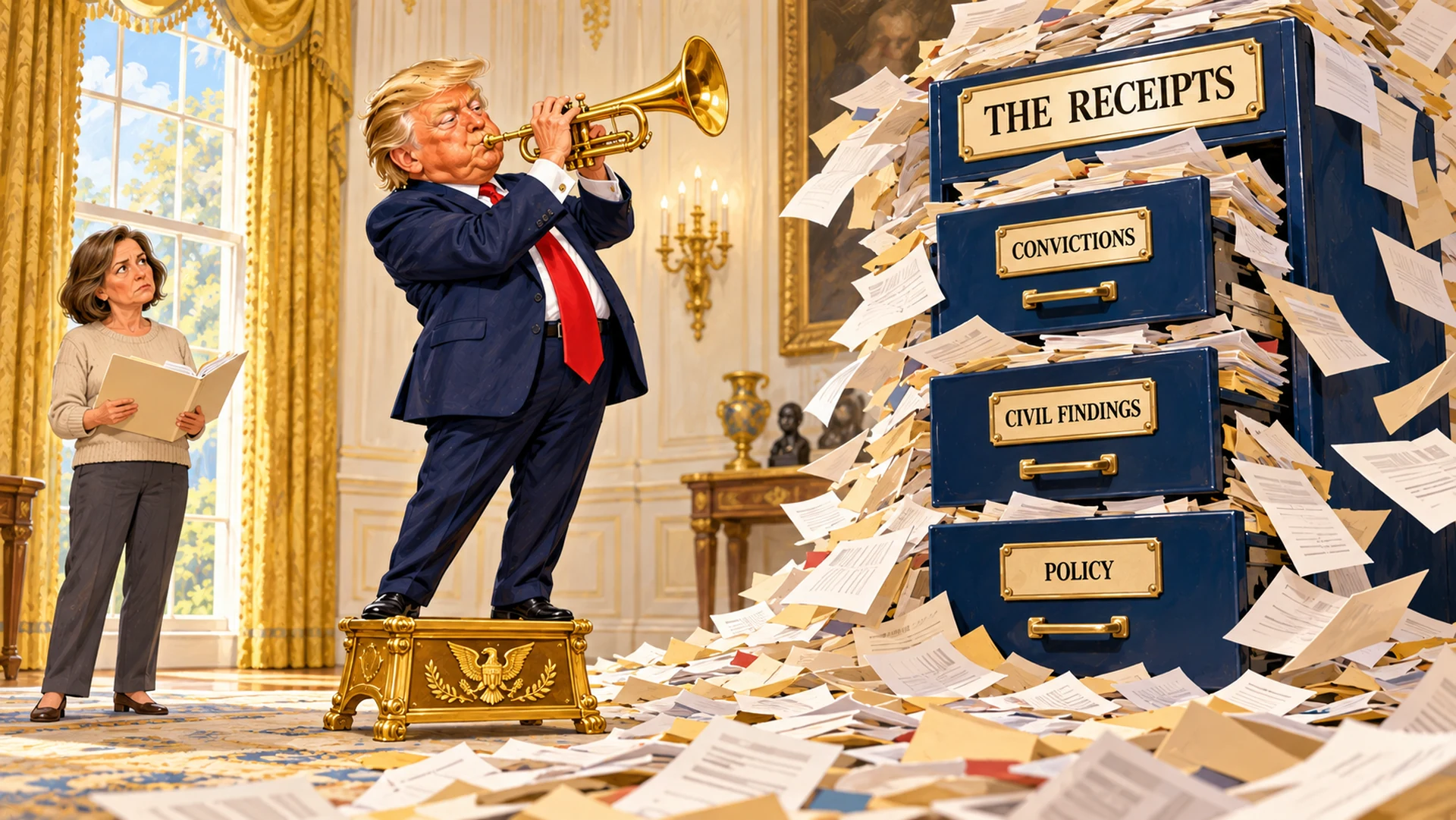
Trumpet Baby can blow his own horn until the gold plating peels. The record is still there: felony convictions, civil findings, a substantial Epstein history, the pussy-grabbing tape, pageant dressing rooms, hush money, six corporate bankruptcies, election lies, DOGE's bills, and a Bible photo op. Here are 66 sourced entries, including twelve devoted to Epstein: the friendship, flights, recruitment history, disputed documents, serious allegations, and the government's handling of the files. Each entry identifies what the evidence establishes and what remains disputed. The cabinet is large. It still is not every controversy.
Key takeaways
- Trump's personal felony convictions, civil findings, settlements, and his companies' convictions are different legal outcomes. Each is identified below.
- Epstein has a dedicated twelve-entry section near the top. It separates documented ties and government actions from disputed authorship, attributed accounts, and unverified allegations.
- The legal status is checked as of October 5, 2026. Source links support the facts; the trumpet performance is an invented cartoon.
Record checked: October 5, 2026. The legal labels below describe the outcomes. Trump disputes many findings and allegations. Court decisions, government documents, and attributed reporting supply the factual record; the judgments and jokes are ours.
Jump to: Court record · Epstein · Personal record · Democracy · People · Public costs · Ethics · FAQs
The court record. Bring a bigger folder.
1. Thirty-four felony convictions.
Criminal conviction. A New York jury convicted Trump in May 2024 of 34 counts of falsifying business records in the hush-money case. His January 2025 sentence was an unconditional discharge: no prison, fine, or probation. The conviction remained, and he continued challenging it. In August 2026, a federal judge again rejected moving the already-decided case into federal court. The law-and-order salesman has a criminal record.
Receipts: Reuters, August 28, 2026.
2. A jury found him liable for sexually abusing E. Jean Carroll.
Civil finding. The 2023 civil jury awarded Carroll $5 million for sexual abuse and defamation. In August 2026, the Supreme Court rejected Trump's final request to reconsider its refusal to hear his appeal; Carroll's representatives said the award had been paid. Trump denies wrongdoing. This was a civil finding, not a criminal sex-offense conviction. The distinction matters. So does the finding.
Receipts: ABC News, August 17, 2026.
3. Another Carroll verdict: $83.3 million for defamation.
Civil finding; appeal pending. A separate jury awarded $83.3 million in 2024 over Trump's defamatory 2019 statements about Carroll. The Second Circuit upheld that judgment; his Supreme Court petition remained pending on October 5, 2026. The docket set Carroll's response deadline for October 30. Repeating an attack can become an exceptionally expensive substitute for shutting up.
Receipts: ABC News, August 17, 2026 · Supreme Court docket 26-141.
4. Civil fraud, with the appeal reported accurately.
Civil finding; monetary award vacated. New York's courts found Trump and other defendants liable for persistent business fraud involving misleading financial statements. In August 2025, the appellate court vacated the disgorgement awards while otherwise affirming the judgment, including liability. That means the enormous monetary award was thrown out; the fraud finding was not. Even a roast should read past the headline.
Receipts: New York appellate opinion, August 21, 2025.
5. The charity money needed adult supervision.
Civil court order. In 2019, a court ordered Trump to pay $2 million over misuse of Trump Foundation funds for political and personal purposes. He admitted facts concerning the misuse, and the foundation was dissolved. Charity is supposed to help other people. Apparently that required clarification in writing.
Receipts: New York attorney general and court order, November 7, 2019.
6. Trump University: the education ended in a $25 million settlement.
Civil settlement; no admission of wrongdoing. Trump agreed in 2016 to a $25 million settlement resolving fraud litigation over Trump University. He did not admit wrongdoing. Students had sued over the real-estate program and its sales promises. The settlement is a documented outcome, not a criminal conviction. An expensive lesson in the difference between selling success and delivering it.
Receipts: ABC News, November 18, 2016 · Court-approved settlement FAQ.
7. His companies' tax-fraud convictions belong in their own column.
Corporate criminal convictions. Two Trump Organization entities were convicted in December 2022 on all 17 charged counts in a tax-fraud scheme and sentenced to the maximum fines, totaling approximately $1.61 million. Trump himself was not charged in that trial. Those corporate counts cannot honestly be added to his 34 personal counts. The company still earned its own folder.
Receipts: Manhattan district attorney, January 13, 2023.
8. The housing-discrimination case predates the presidential merchandise.
Civil lawsuit and consent decree. The Justice Department sued Donald Trump, his father, and their company in 1973 for alleged racial discrimination against Black rental applicants. A 1975 consent decree imposed anti-discrimination requirements without an admission of liability. This history is documented in the court record. The government did not need a campaign slogan to take an interest in the rental office.
Receipts: Civil Rights Litigation Clearinghouse: case and court documents.
9. Six corporate bankruptcies. The business genius needed Chapter 11.
Corporate bankruptcy reorganizations. Six Trump businesses sought bankruptcy protection: Trump Taj Mahal in 1991; Trump Castle, Trump Plaza and Casino, and New York's Plaza Hotel in 1992; Trump Hotels and Casino Resorts in 2004; and Trump Entertainment Resorts in 2009. These were corporate Chapter 11 reorganizations, not personal bankruptcy filings or criminal convictions. Trump defended using the law. Fine: the law exists. So does the record of failed financial promises. Trump University belongs in the separate settlement drawer.
Receipts: FactCheck.org on all six filings, September 27, 2016.
The cases that did not reach a verdict. The other criminal cases do not supply extra convictions. The federal election-interference and classified-documents prosecutions ended without trial verdicts against Trump. Georgia's election-interference charges were dismissed in November 2025. An indictment is an allegation, and a dismissal is a procedural outcome; neither is a guilty jury verdict. Reuters explains the four-case record.
Epstein: the friendship, the files, and the answers still owed.
Epstein's victims deserve an account that follows the evidence. Trump's ties and his administration's handling of the files merit sustained scrutiny. The entries below cover the public record through October 5, 2026. An allegation in a released file remains an allegation; a documented friendship remains a documented friendship. The distinctions make the record more useful, not less serious.
10. The friendship has footage.
Documented social association. NBC's archive footage shows Trump and Epstein together at a 1992 party at Mar-a-Lago. Reuters also documents their extensive socializing in the 1990s and early 2000s. This was an actual relationship among wealthy men, with a public record. Trump says it ended years before Epstein's 2019 arrest and denies knowledge of his crimes. The footage establishes contact. It does not establish participation in abuse. It does make the friendship impossible to wave away as a random name in a spreadsheet.
Receipts: NBC archive footage, published by CNBC Television in July 2019 · Reuters factbox on the documented relationship, February 2026.
11. "Terrific guy." The endorsement aged catastrophically.
Published 2002 remarks. In 2002, Trump called Epstein a "terrific guy" in a New York magazine profile and remarked that some women Epstein liked were "on the younger side." That is Trump's own published praise, before Epstein's 2008 conviction. It does not prove he knew about crimes. It does give the later distancing campaign some exceptionally inconvenient copy to explain.
Receipts: ABC News reproduces the 2002 remarks and later explanations, July 2025.
12. The flight records do not match the never-on-the-plane claim.
Prosecutor's description of flight records; Trump's denial. A January 2020 prosecutor's email, released by DOJ in December 2025, said flight records showed Trump on Epstein's jet eight times during the 1990s, with Maxwell aboard at least four flights. Reuters contrasted that with Trump's 2024 claim that he had never been on the plane. The email did not accuse him of a crime. Nor does a flight establish an island visit or sexual abuse. A categorical denial still has to survive a passenger record.
Receipts: Reuters on the email, eight flights, and Trump's denial, December 23, 2025.
13. Giuffre's recruitment story leads to Mar-a-Lago.
Survivor's account and employment records. Virginia Giuffre said Maxwell recruited her while she was a minor working at Mar-a-Lago's spa. Employment records submitted in litigation place her there in summer 2000. In July 2025, Trump acknowledged Giuffre among staffers he said Epstein had taken from him. This does not establish that Trump arranged the abuse. It does make the route from his club to Epstein's circle a serious part of the history. Giuffre was a person, not a staffing dispute.
Receipts: PolitiFact on Giuffre's account, employment records, and Trump's comments, July 31, 2025.
14. The falling-out explanation keeps needing another version.
Public explanations and attributed historical reporting. Trump said in 2019 that he had not spoken with Epstein for about 15 years. In 2025, he described a rupture over Epstein taking spa employees. Other reporting tied the rift to a 2004 property auction or inappropriate behavior toward a member's teenage daughter in 2007. The exact sequence remains unsettled. The changing accounts deserve scrutiny without pretending the sources resolve every date. A break with a predator should have a clearer explanation than a recycled personnel complaint.
Receipts: ABC News compares the accounts of the rupture, July 2025 · PolitiFact examines the three reported explanations.
15. The birthday book contains a disputed Trump letter.
Estate document released by Congress; authorship denied. Congress received Epstein's 2003 birthday book from his estate and released it in September 2025. It includes a sexually suggestive note that appears to bear Trump's signature. Trump and the White House denied its authenticity. The book's production by the estate is documented; Trump's authorship remains disputed in this account. A suggestive birthday note is not a conviction. A disputed document also cannot be made to disappear simply by yelling at the newspaper that reported it.
Receipts: House Oversight's Republican-led release of estate records, September 8, 2025 · Reuters on the book, alleged letter, and White House denial.
16. The police chief's account raises the knowledge question.
FBI interview summary; corroboration disputed. A 2019 FBI interview summary records former Palm Beach police chief Michael Reiter saying Trump called in July 2006, after Epstein's charges became public, and said "everyone has known he's been doing this." Reiter confirmed his account to the Miami Herald. DOJ said it knew of no corroborating evidence of the call; the White House said it did not know whether it happened. Trump denies knowing about Epstein's crimes. This is an attributed account, not an audio recording or a finding about what Trump knew before the charges.
Receipts: Reuters on Reiter's account and the government's response, February 10, 2026.
17. Epstein's emails make claims that require examination.
Released correspondence; claims by Epstein. House Democrats released emails in November 2025 in which Epstein wrote that Trump "knew about the girls." Reuters noted that the phrase's meaning was unclear. Another released email said Trump visited his house but never received a massage. Trump consistently denies knowledge of the trafficking. These are Epstein's statements, not established facts about Trump's conduct. Read the correspondence, its context, and the denials together. A dead abuser's email is evidence of what he wrote, not an automatic verdict about someone else.
Receipts: House Oversight Democrats' release of the correspondence, November 12, 2025 · Reuters reports the claims, context, and Trump's denial.
18. The FBI interviews contain a serious, unverified allegation.
Reported allegation; denied; not independently verified. In March 2026, DOJ released summaries of previously omitted FBI interviews with a woman who accused Trump of an attempted sexual assault after Epstein introduced them in the 1980s, when she said she was between 13 and 15. The White House called the accusations baseless. Reuters could not independently verify them. DOJ said the omitted records had been incorrectly marked as duplicates. Reporting the allegation requires those limits to appear beside it. Its presence in an FBI file proves that investigators recorded it, not that it happened.
Receipts: Reuters on the interviews, allegation, denial, and release explanation, March 5, 2026.
19. Maxwell's interview and prison move deserve their own receipts.
DOJ interview and prison transfer; lawmakers' concerns. Deputy Attorney General Todd Blanche, previously Trump's personal criminal lawyer, interviewed Maxwell in July 2025. She said she never witnessed Trump behaving inappropriately. Roughly a week later, she moved from a low-security prison to a minimum-security camp. Senator Sheldon Whitehouse sought records about the unusual transfer and possible special treatment. The sequence is documented; it does not establish a political bargain. Maxwell's favorable account is not a court's exoneration either. The public deserves the reasons for the decisions, not a choice between automatic belief and automatic conspiracy.
Receipts: Reuters on Maxwell's answers, Blanche's role, and the transfer, August 22, 2025 · Senator Whitehouse's August 7, 2025 request for transfer records.
20. Transparency was promised. Then further disclosure was rejected.
Official releases and July 2025 DOJ/FBI decision. In February 2025, Bondi's Justice Department presented its first release as fulfillment of Trump's transparency commitment, while acknowledging that much of the material had previously leaked. In July, DOJ and the FBI said their review found no incriminating client list or basis to investigate uncharged third parties and concluded that further disclosure was unwarranted. Those are the agencies' stated findings. The policy reversal is also documented. Selling disclosure and then closing the desk was a reasonable cause for public distrust.
Receipts: DOJ's first-phase announcement, February 27, 2025 · DOJ/FBI July 2025 memorandum.
21. The release process itself became an oversight problem.
Disclosure law, additional releases, and announced watchdog review. Trump signed the Epstein Files Transparency Act in November 2025. In January 2026, DOJ announced a total release of nearly 3.5 million pages and claimed compliance. The later disclosure of omitted interviews sharpened questions about that process. In April, DOJ's inspector general announced a review of how records were identified, redacted, and released. That announcement is not a completed finding of deliberate concealment. Victims' identities need protection, and the release process needs scrutiny. Neither duty is satisfied by a giant page count and a victory announcement.
Receipts: DOJ announces its releases and stated compliance, January 30, 2026 · Reuters on the inspector general's announced review, April 23, 2026 · Reuters on the omitted interview summaries, March 5, 2026.
The family-values sales pitch.
22. "Grab them by the pussy." His words.
Recorded remarks. On the 2005 Access Hollywood tape, released in 2016, Trump said, "Grab them by the pussy," after describing kissing women without waiting and claiming that being a star let him do it. He called it locker-room talk. This is a recording of his boast, not a separate criminal verdict. The objection is the entitlement he described. Changing the room's name does not improve the sentence.
Receipts: CNN transcript reproducing the recording, October 14, 2016 · Reuters on the tape and the 2016 campaign.
23. The pageant owner described inspecting the dressing room.
Recorded remarks about adult pageants. In a 2005 Howard Stern interview about Miss USA and Miss Universe, Trump described going backstage while contestants were undressed and justified access by saying he owned the pageant and could inspect it. These were adult pageants. The relevant name is not Miss America. Owning the event apparently came with an extraordinarily convenient definition of quality control.
Receipts: PolitiFact separates Trump's remarks from the teen-pageant allegations, October 18, 2016.
24. Teen contestants made separate dressing-room allegations.
Reported allegations; denied by campaign. Former contestants in the 1997 Miss Teen USA pageant reported that Trump entered their dressing room while they were changing; some contestants were as young as 15. Other participants did not remember such an incident or doubted it. His campaign denied the reports. These allegations deserve their own entry, with their status intact. His adult-pageant interview is not a confession to this separate incident.
Receipts: PolitiFact's account of contestants' reports and the campaign response.
25. The family-values brochure went through three marriages.
Documented personal history. Trump married Ivana in 1977. Their divorce was finalized in 1992 after his widely reported affair with Marla Maples. He married Maples in 1993; they separated in 1997 and divorced in 1999. He married Melania in 2005. Divorce is not a crime. The criticism concerns the gap between moral lecturing and his own infidelity, not a demand that every marriage survive. The brochure could at least disclose its previous editions.
Receipts: University of Virginia Miller Center: Trump's family history · Reuters on Ivana and the Maples affair, July 14, 2022.
26. Stormy Daniels: $130,000 to keep the story quiet.
Documented payment; alleged encounter denied. Michael Cohen paid adult-film performer Stormy Daniels $130,000 shortly before the 2016 election to suppress her account of a sexual encounter with Trump. Trump denies the encounter. Federal prosecutors documented Cohen's payment and reimbursement through falsely described legal retainers; the later New York verdict addressed Trump's falsified business records. The payment is documented. The alleged sex is not a separate conviction. Family values apparently needed an accounts-payable department.
Receipts: Justice Department on Cohen's payments and reimbursements, December 12, 2018 · Reuters on Daniels, McDougal, and the trial testimony, May 13, 2024.
27. Karen McDougal: another story bought to disappear.
Documented catch-and-kill arrangement; alleged affair denied. National Enquirer publisher American Media paid former Playboy model Karen McDougal $150,000 for rights to her account of an affair with Trump, then suppressed it. Trump denies the affair. American Media admitted that the payment's purpose included protecting his campaign from the story's electoral effect. The publisher made this payment; it was not another $150,000 check from Trump. A tabloid that buys a story to bury it is doing campaign work with a checkout counter.
Receipts: Justice Department on American Media's admitted purpose, December 12, 2018 · Reuters identifies McDougal and the $150,000 arrangement.
Democracy, subject to his approval.
28. He kept selling the lie that he won in 2020.
Documented conduct; congressional findings. Trump lost the 2020 election and repeatedly claimed it had been stolen. The January 6 committee documented warnings from advisers and officials that his major fraud claims lacked support, followed by his continuing effort to overturn the result. Losing an election is ordinary. Demanding that the country reorganize reality around the loser is the problem.
Receipts: January 6 committee final report and executive summary.
29. Georgia's election officials got the "find" call.
Recorded conduct. On January 2, 2021, Trump asked Georgia Secretary of State Brad Raffensperger to "find 11,780 votes," the number needed to reverse his loss there. The recorded call is part of the public record. Election administration should not require a presidential request for precisely enough additional votes to make the president happy.
Receipts: January 6 report, chapter 2, including the recorded call.
30. Pence and the fake-elector scheme.
Congressional findings; no Trump criminal verdict. The January 6 committee documented Trump's pressure on Mike Pence to reject legitimate electoral votes and his role in a scheme involving false elector slates from seven states. These are findings supported by the committee's evidence, not a criminal jury verdict against Trump. Calling the slates an alternative did not turn them into the votes Americans actually cast.
Receipts: January 6 report, chapter 3.
31. January 6, and the wait while the Capitol was attacked.
Congressional findings. The committee's report described Trump's failure to act promptly to stop the attack and the 187 minutes between the end of his rally speech and his video telling the crowd to go home. Police, lawmakers, staff, and his own vice president faced danger while the peaceful transfer of power was disrupted. This deserves more than a cute nickname.
Receipts: January 6 committee executive summary and findings.
32. Twice impeached. Twice acquitted.
Impeachment record. The House impeached Trump in 2019 for abuse of power and obstruction of Congress and in 2021 for incitement of insurrection. The Senate acquitted him both times. In the second trial, 57 senators voted guilty, short of the required two-thirds. Impeachment is not a criminal conviction; acquittal does not erase the articles or the votes.
Receipts: U.S. Senate impeachment case list · 2021 Senate verdict roll call.
33. Ukraine aid became part of a presidential pressure campaign.
Government watchdog finding. The Government Accountability Office concluded that the Office of Management and Budget violated the Impoundment Control Act by withholding Ukraine security assistance in 2019 for a policy reason. This was a finding about the administration's handling of congressionally appropriated money, not a personal criminal conviction. Congress's purse does not become the president's leverage just because he wants something.
Receipts: GAO decision B-331564, January 16, 2020.
34. Then the January 6 defendants got clemency.
Presidential action. On January 20, 2025, Trump granted sweeping pardons for January 6-related offenses, commuted the sentences of 14 named people, and directed dismissal of pending cases. The proclamation is available to read. Our earlier loyalty-discount joke came with presidential paperwork.
Receipts: White House clemency proclamation, January 20, 2025.
35. Law firms learned that the president had a grievance list.
Executive action; district-court ruling under appeal. Trump targeted law firms with executive orders threatening security clearances, contracts, and access. A federal judge struck down the Perkins Coie order in May 2025 as unconstitutional, including on free-speech and due-process grounds. The administration pursued appeals in 2026. A lawyer representing someone the president dislikes should not become a government retaliation project.
Receipts: Reuters on the Perkins Coie ruling, May 2, 2025 · Reuters on the government's appeals, March 6, 2026.
36. Vote Republican and collect $5,000. Terms and legislation not included.
Election-linked payment promise. At his September 2026 midterm convention speech, Trump promised every adult citizen a $5,000 dividend if Republicans won both the House and Senate, suggesting tariff revenue would fund it. FactCheck.org found the arithmetic implausible at the revenue rate he cited. A campaign promise is not an enacted payment program, and this entry is not a court finding of criminal vote buying. It is a president explicitly tying a cash promise to his party's electoral victory. The game-show pitch has receipts too.
Receipts: FactCheck.org on the speech, conditions, and cost, September 10, 2026.
37. The waste-and-fraud watchdogs were fired.
Presidential removals; September 2025 court finding. Trump fired at least 17 inspectors general early in his second term. In September 2025, Judge Ana Reyes found the removals of eight who sued unlawful because Congress had not received the required 30-day notice and reasons. She nevertheless declined to reinstate them because the necessary irreparable harm was not established. That historical ruling is narrower than saying every firing was permanently reversed. An administration advertising a war on waste removed the people assigned to inspect it.
Receipts: Reuters on the unlawful process and denied reinstatement, September 24, 2025.
38. The Associated Press lost access over a map label.
Documented White House restriction. In February 2025, the White House barred an AP reporter from an Oval Office event after demanding that the news service adopt Trump's Gulf of America wording. AP continued using Gulf of Mexico for its global audience while acknowledging the U.S. name change. This entry describes that access restriction, not a claim about the final outcome of subsequent litigation. Independent coverage apparently needed to pass a presidential vocabulary test.
Receipts: Associated Press on the February 11, 2025 restriction.
The people on the receiving end.
39. Family separation required families to pay for the policy.
Administration policy; inspector-general findings. The 2018 zero-tolerance policy separated children from parents at the border. HHS's inspector general documented planning and communication failures that impeded the response, including inadequate information for identifying and reunifying separated families. The cruelty was experienced by real children. A filing failure did not make it less real.
Receipts: HHS inspector general report, 2020.
40. The travel ban.
Executive policy; final version upheld by Supreme Court. Trump imposed entry restrictions affecting several predominantly Muslim countries. Critics challenged the policy as discriminatory; his administration defended it as a security measure. The Supreme Court upheld the later version in Trump v. Hawaii in 2018. That legal outcome belongs in the record alongside the policy and the reasons people opposed it.
Receipts: Supreme Court: Trump v. Hawaii, 2018.
41. An executive order tried to shrink birthright citizenship.
Executive action rejected by Supreme Court. Trump's 2025 order attempted to deny citizenship to some U.S.-born children based on their parents' immigration status. In Trump v. Barbara, decided June 30, 2026, the Supreme Court rejected that interpretation and affirmed citizenship for the children at issue. The Constitution does not come with a presidential edit button.
Receipts: Supreme Court: Trump v. Barbara, June 30, 2026.
42. A wrongful deportation reached the Supreme Court.
Admitted removal error; court order. The government acknowledged that it improperly sent Kilmar Abrego Garcia to El Salvador in March 2025 despite an order protecting him from removal there. The Supreme Court required the government to facilitate his release and handle his case as it would have without the improper removal. This entry concerns that admitted removal error, not a verdict about unrelated allegations against him.
Receipts: Supreme Court: Noem v. Abrego Garcia, April 10, 2025.
43. His three Supreme Court appointees helped overturn Roe.
Judicial appointments and Supreme Court decision. Neil Gorsuch, Brett Kavanaugh, and Amy Coney Barrett joined the Dobbs majority that overruled Roe v. Wade and Planned Parenthood v. Casey in 2022. Trump did not personally issue a nationwide abortion ban; his appointments helped remove the federal constitutional protection. For people whose access to abortion disappeared afterward, the distinction does not make the consequences smaller.
Receipts: Supreme Court: Dobbs v. Jackson Women's Health Organization.
44. Transgender service members became another exclusion project.
Administration policy; litigation continued. Trump's administration moved to bar transgender people from military service in 2025. In May, the Supreme Court allowed enforcement while the litigation proceeded; that was not a final ruling on the policy's merits. Service members who had already done the job faced a government deciding that their identity was the problem.
Receipts: Reuters on the Supreme Court's interim order, May 6, 2025.
45. Birtherism: a lie with a long promotional tour.
False public claim. Trump promoted the false claim that Barack Obama was not born in the United States. In September 2016, he finally acknowledged Obama's U.S. birth while falsely blaming Hillary Clinton for starting the controversy. Demanding proof from the first Black president did not become an innocent paperwork question because Trump eventually stopped selling it.
Receipts: FactCheck.org, September 16, 2016.
46. John McCain's captivity became a punch line.
Recorded public remarks. In 2015, Trump disparaged McCain's status as a war hero and said, "I like people who weren't captured." McCain had been a prisoner of war in Vietnam. No criminal charge is needed to understand why veterans and their families might despise that remark.
Receipts: Associated Press via PBS, July 18, 2015.
47. Immigrants were described as poisoning the country's blood.
Recorded public rhetoric. Trump repeatedly used the phrase "poisoning the blood" about immigrants in 2023. The language drew condemnation as xenophobic and comparisons to Nazi rhetoric; Trump denied drawing inspiration from Hitler. People hearing themselves portrayed as contamination have a reason to object that does not depend on liking the opposing party.
Receipts: Reuters, December 2023.
48. Springfield's Haitian residents got the pet-eating lie.
False public claim. During the September 2024 debate, Trump repeated the false story that immigrants in Springfield, Ohio, were eating residents' pets. City officials said they had no credible reports supporting it. A presidential candidate put a vulnerable community into a national spectacle using a claim that did not survive a basic check.
Receipts: Reuters, September 11, 2024.
49. The Central Park Five were exonerated. The attacks continued.
Documented advertisements and false public statements. During the 1989 Central Park case, Trump bought newspaper ads calling for restoration of the death penalty. The five wrongly convicted men were exonerated in 2002 after DNA evidence and another man's confession. In the 2024 debate, Trump falsely said they had killed someone and pleaded guilty. Neither claim was true. A 2025 judge allowed their defamation claims to proceed; that was not a trial verdict. Exoneration should end the public punishment, even when correcting the record would interrupt a familiar grievance.
Receipts: Reuters on the history, debate claims, and April 2025 ruling.
The public gets the consequences and the bill.
50. COVID got reassurance when the public needed candor.
Recorded remarks and public conduct. Trump told Bob Woodward in March 2020 that he wanted to play down the virus despite knowing its danger; he said he wanted to avoid panic. In April, he publicly mused about researching disinfectant by injection and later claimed sarcasm. He did not order Americans to drink bleach. The accurate account is damaging enough without adding an invented instruction.
Receipts: Reuters on Woodward's recordings, September 2020 · Reuters on the disinfectant remarks, April 24, 2020.
51. The tariff bill did not magically go overseas.
Federal trade-agency findings. The U.S. International Trade Commission's 2023 study found that U.S. importers bore nearly the full cost of the Section 232 and 301 tariffs it examined, through higher import prices. That is a finding about those tariffs and that period, not every tariff forever. Calling a tax on imports a bill paid by foreigners does not change who pays at customs.
Receipts: U.S. International Trade Commission, March 15, 2023.
52. His emergency tariff authority failed at the Supreme Court.
Supreme Court ruling. In February 2026, the Supreme Court ruled that the International Emergency Economic Powers Act did not authorize Trump's sweeping global tariffs. The ruling concerned that statute; it did not erase every tariff imposed under other laws. Declaring an emergency did not supply a power Congress had not granted.
Receipts: Reuters, February 20, 2026.
53. The 2025 budget law is projected to leave more people uninsured.
Enacted policy; CBO projection. CBO projected that the health provisions of the law Trump signed on July 4, 2025, would increase the uninsured population by 10 million in fiscal 2034 relative to its baseline. That is a projection, not a claim that 10 million people have already lost coverage. For the people affected, an insurance card is more useful than an adjective in the bill's nickname.
Receipts: Congressional Research Service summary of CBO's estimates.
54. The deficit got a multi-trillion-dollar forecast.
Enacted policy; CBO projection. CBO estimated that the same 2025 law would add $3.4 trillion to deficits over 2025-2034 before macroeconomic effects and additional debt-service costs. This is a ten-year estimate, not the current annual deficit. Fiscal responsibility apparently requires the audience to stop reading when the number becomes inconvenient.
Receipts: CBO estimate of Public Law 119-21.
55. Paris climate cooperation got another exit order.
Presidential action. In January 2025, Trump ordered the United States to withdraw again from the Paris Agreement and revoke the U.S. international climate-finance plan. His order explains the administration's stated America First rationale. Critics can read that rationale and still conclude that walking away from international climate cooperation makes a shared problem harder to solve.
Receipts: White House executive order, January 20, 2025.
56. USAID programs were cut on an enormous scale.
Administration action. Secretary of State Marco Rubio said in March 2025 that 83% of USAID programs were being canceled after the administration's review. Reuters documented cuts across aid work, including health programs. The administration defended the cuts as serving U.S. interests. The percentage describes programs, not an 83% calculation of deaths or spending. People who depended on the work were more than a line in the announcement.
Receipts: Reuters, March 10, 2025.
57. The Iran war has a human cost that will not fit in a slogan.
Presidential military action; attributed reporting. Trump began the war against Iran on February 28, 2026. AP's October 5 investigation describes six U.S. soldiers killed in a March 1 drone strike in Kuwait and survivors and Gold Star families demanding answers about preparedness and medical care. The Pentagon has defended the medical care as appropriate. These allegations require investigation; they are not findings that Trump personally caused each failure. The dead and wounded still belong in the cost of his war.
Receipts: Associated Press via The Journal, October 5, 2026 · AP on disputed medical care, October 5, 2026.
58. The checks arrived just in time for the election season.
Announced government payments; distribution reporting. In October 2026, the administration announced a one-time $90 rebate for more than 20 million eligible Medicare enrollees. Separately, Reuters reported nearly one million $500 ACA refunds, with 71% of the money going to 13 states with competitive statewide races. The White House described the ACA payments as refunds for overcharges. These are government programs, not Trump's personal gifts. Their timing and distribution invite scrutiny; they do not by themselves prove criminal vote buying. The taxpayer gets to sponsor the confetti.
Receipts: White House Medicare rebate fact sheet, October 2026 · Reuters on the $500 refunds and battleground distribution, October 1, 2026.
59. DOGE's efficiency came with a paid-leave bill.
Government watchdog estimates; data limitations. GAO estimated that agencies paid $9.5 billion in administrative-leave salaries in 2025, roughly six times the 2023 amount. Approximately $6.7 billion was associated with the deferred-resignation program, which let participating employees stop working while remaining paid through September 2025. The estimates have data limitations; the entire $9.5 billion cannot be assigned to DOGE, and these figures do not measure eventual net savings. They do show why an efficiency slogan needs an actual balance sheet. Paying people to leave is still paying people.
Receipts: GAO: Federal Workforce administrative leave, September 15, 2026.
60. DOGE's savings scoreboard misplaced three zeroes.
Reported claim and correction. In February 2025, DOGE initially counted an ICE contract as an $8 billion saving; its actual ceiling was $8 million. The government's original contract record contained an error, and DOGE's figure was subsequently corrected. ABC also found its broader $55 billion savings claim difficult to verify. A contract ceiling is not necessarily money that would have been spent. An audit should establish savings before the victory lap, preferably without borrowing three extra zeroes.
Receipts: ABC News examines DOGE's figures and the corrected contract, February 19, 2025.
Access, loyalty, and extremely convenient friendships.
61. A presidential dinner became a meme-coin promotion.
Documented business promotion; ethics concerns. Top holders of the Trump-branded meme coin were offered a private dinner with the president in May 2025. Reuters documented the spending competition and concerns about buying access. The White House said Trump's assets were in a trust managed by his children. This is an access-and-conflict story, not a proven criminal-bribery verdict. The presidency should not need a customer leaderboard.
Receipts: Reuters, May 13, 2025.
62. Qatar's plane: foreign generosity with a security bill.
Government gift; legal and ethics concerns. The U.S. government accepted a Qatari aircraft for presidential use, drawing legal, security, and ethics criticism. By July 2026, Reuters reported Trump had flown on it and wanted further upgrades. Describe the recipient accurately: this was a gift to the government, not an established personal cash bribe to Trump. That clarification does not make the questions about influence and public costs disappear.
Receipts: Reuters legal explainer, May 15, 2025 · Reuters on use and upgrades, July 2026.
63. The pardon power was very useful to his allies.
Presidential clemency. Trump pardoned Roger Stone and Paul Manafort in December 2020 and Steve Bannon in January 2021. Stone and Manafort had been convicted; Bannon's federal pardon came before trial in that fundraising case. The Justice Department lists the grants. Loyalty had a remarkably good customer-service department.
Receipts: Justice Department: Trump's 2017-2021 pardons.
64. Helsinki gave Putin a very accommodating stage.
Public remarks. Standing beside Vladimir Putin in 2018, Trump cast doubt on U.S. intelligence conclusions about Russian election interference while highlighting Putin's denial. The next day, he said he had misspoken and accepted the intelligence assessment. This is a record of his statements and correction, not proof that he was a Russian agent. Americans had every reason to scrutinize the performance.
Receipts: FactCheck.org on the remarks and subsequent correction.
65. Natalie Harp: the Oval Office's personal gatekeeper.
Reported staff access; romantic relationship unestablished. CNN's August 2026 reporting described aide Natalie Harp's exceptional access to Trump, including accompanying meetings, handling social-media matters, and serving as a route for people seeking the president. It also discussed affectionate letters attributed to her, while explicitly saying CNN had not independently confirmed she wrote or sent them. These sources do not establish a romantic relationship. The public issue is the influence of a highly personal gatekeeper. An access badge is enough to examine; a bedroom story cannot be supplied by assumption.
Receipts: CNN transcript on Harp's role and the unverified letters, August 21, 2026.
66. The Bible got a photo op outside St. John's.
Documented event; bishop's criticism; watchdog scope. On June 1, 2020, Trump walked to St. John's Church and posed holding a Bible. Bishop Mariann Budde condemned using the church for his message and said she received no advance notice. Our criticism is the staged religious symbolism. The later Interior watchdog found that evidence did not support the claim that U.S. Park Police cleared Lafayette Park specifically for his visit: its fencing plan preceded knowledge of his movement. That review did not cover every agency's actions. The photo op is real; the motive for every police action cannot be invented to sharpen the joke.
Receipts: ABC News interviews Bishop Budde, June 2, 2020 · Interior inspector general: scope and findings of the Lafayette Park review, June 2021.
The horn is loud. The filing cabinet is louder.
People can oppose a president for what he was convicted of, what civil juries found, what he said on tape, what his government did, and what his policies cost them. They do not owe him affection until every objection comes with a criminal sentence. They do deserve an accurate account of why the objection exists.
Our opinion: the pattern is exhausting. Power becomes personal, criticism becomes disloyalty, and consequences get handed to somebody else. Rebranding it as Super Intelligence does not improve the paperwork. The cabinet still needs another drawer.
More receipts: January 6's loyalty discount · The source desk · Super, My Ass.
Artwork disclosure: an original AI-created political cartoon. The trumpet performance, filing cabinet, and documents are fictional satire, not a photograph or a reproduction of legal evidence.
FAQs
What has Trump personally been convicted of?
A New York jury convicted him of 34 felony counts of falsifying business records in the hush-money case. He received an unconditional discharge in January 2025 and continued challenging the conviction. The separate Trump Organization tax-fraud counts were corporate convictions, not additional personal convictions.
Were the Carroll and New York fraud cases criminal convictions?
No. Carroll's cases produced civil findings of sexual abuse and defamation. The New York business-fraud case was also civil; the appellate court vacated its monetary disgorgement awards while preserving liability. These outcomes should be described accurately.
Does a name in the Epstein files prove criminal wrongdoing?
No. A photograph, flight record, or file mention does not establish a sexual offense. The dedicated section identifies documented contact, disputed documents, attributed accounts, and an unverified allegation alongside the denials. These sources do not establish a Trump criminal conviction for Epstein-related conduct.
Is this a complete list of everything people dislike about Trump?
No. It covers 66 major documented entries through October 5, 2026. Dislike is a judgment, not a court finding. The article provides evidence readers can evaluate and identifies the legal or factual status of each entry.