Pete Hegseth has found a new way to run the Pentagon: as a television studio with an unusually expensive props department. In our imaginary production meeting, the generals bring military briefings, Pete brings a headset, and Donald brings guests who make the security desk reconsider its career choices.
Somebody get Pete a director's chair
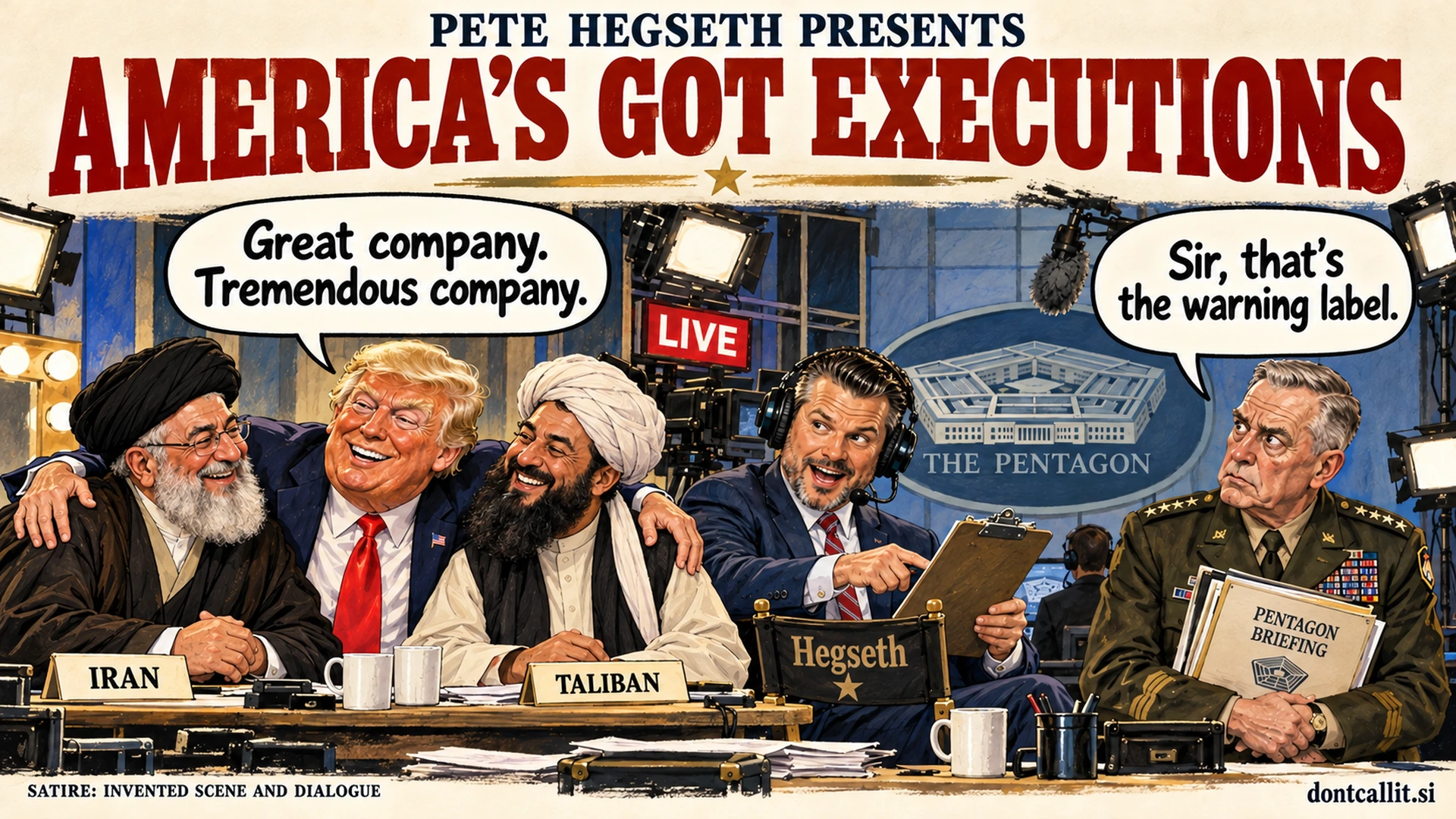
Pete settles into a canvas chair and adjusts a headset large enough to intercept NATO. "Can we move it to prime time?" he asks. An exhausted general lowers his briefing folder. "Sir, this is an execution, not your comeback special."
Donald arrives halfway through the meeting and immediately identifies the national-security priority: "Make sure they get my good side." A camera operator rotates the camera. Donald rotates with it. Pete asks whether they can get a second camera to cover Donald watching the first camera.
An aide places a military briefing on the table. Pete asks whether it is the script. The aide says it describes his responsibilities. Pete hands it back for a rewrite. "My character needs a clearer motivation." Donald suggests putting his name on the cover so people will know who the story is about.
Pete finds his peer group
AP reports that Iran and Afghanistan were the only countries where Amnesty International documented public executions last year. In our imaginary meeting, Pete reads this as market research. He has finally found an exclusive club, and the membership requirements are apparently a camera and no shame.
Two invented officials, one representing Iran's government and the other the Taliban, join the production pitch. Donald wedges himself between them, throws an arm around each, and beams at Pete's clipboard like they have just discovered a timeshare with no extradition clause. "Great company. Tremendous company," he announces.
The general points at the comparison. "Sir, that's the warning label." Donald nods enthusiastically. He knows all about labels. Could they put this one in gold?
Pete adds "international acclaim" to his production notes. The general crosses it out and writes "international embarrassment." Donald studies the correction. "Too long. Just call it Trump TV."
Back in our imaginary meeting, Pete asks the general to estimate the audience. The general says he would rather estimate the damage. Pete writes "two estimates pending" and asks whether the generals can stand closer together. Apparently the military looks more efficient in a tighter shot.
An aide suggests a warning before the broadcast. Pete asks whether warnings improve the ratings. The general says this one is for whoever keeps letting Pete approve things. Donald requests a warning in larger letters, provided his name gets larger letters still.
The title card arrives. It says "United States Government" across the top. Donald studies it with the expression of a man who has discovered somebody else's name on his hotel.
"Where's my name?" he asks. The general explains that this is a government announcement. "Exactly," says Donald. "Who's the executive producer?"
Pete orders another revision. The general closes his briefing folder, which has now survived three camera rehearsals without being opened. Asked whether they are ready to go live, he says they are ready for adult supervision.
"Fine," says Pete. "Can it be here before makeup?"
The real announcement
Hasan killed 13 people and wounded 32 in the 2009 Fort Hood shooting. The Army scheduled his execution for December 3, 2026, at 1 p.m. Central, and says Trump approved the death sentence on October 2.
Hegseth said, "We'll make sure that people are able to watch it, that it's public." A Pentagon official subsequently confirmed the livestream plan. AP's October 9 update reports that Trump remained noncommittal about the broadcast and Vance said he would not watch it. The broadcast remains an announced plan, not a completed event.
More actual paperwork awaits in Receipts. For remedial instruction, report to the Department of Elementary Intelligence. Bring a pencil. Leave the production crew outside.
Three Key Takeaways
- The Pentagon confirmed plans to livestream Nidal Hasan's firing-squad execution, scheduled for December 3 at Fort Hood.
- Trump approved the execution but remained noncommittal about broadcasting it when asked on October 9.
- The production meeting, international guests, and cartoon dialogue are invented. AP's comparison with Iran and Taliban-run Afghanistan is real.
Questions people might actually ask
Is the execution livestream a real plan?
Yes. A Pentagon official confirmed the plan to ABC News on October 8. That announcement does not guarantee the broadcast will happen.
When and where is the execution scheduled?
December 3, 2026, at 1 p.m. Central, at Fort Hood, Texas, according to the Army.
Did Trump publicly endorse the livestream?
He approved the execution but was noncommittal about broadcasting it when asked on October 9.
Did the production meeting actually happen?
No. The meeting, Iranian and Taliban guests, camera demands, title-card argument, and dialogue are invented satire. No reaction or endorsement by those governments is being reported.
Receipts
- AP: how the proposed public execution compares with Iran and Taliban-run Afghanistan, October 9.
- U.S. Army: execution date, location, and presidential approval, October 7.
- Human Events: Hegseth's original interview about making the execution public, October 8.
- ABC News: Pentagon confirmation of the livestream plan, October 8.
- AP's update on Vance's doubts, Trump's response, and opposition to the broadcast, October 9.
- AFP's report on Trump's statement that the broadcast decision is pending, October 9.
Yes, this is dark satire. Unfortunately, the morons are real, and they're doing what they do best: turning everything into a show.