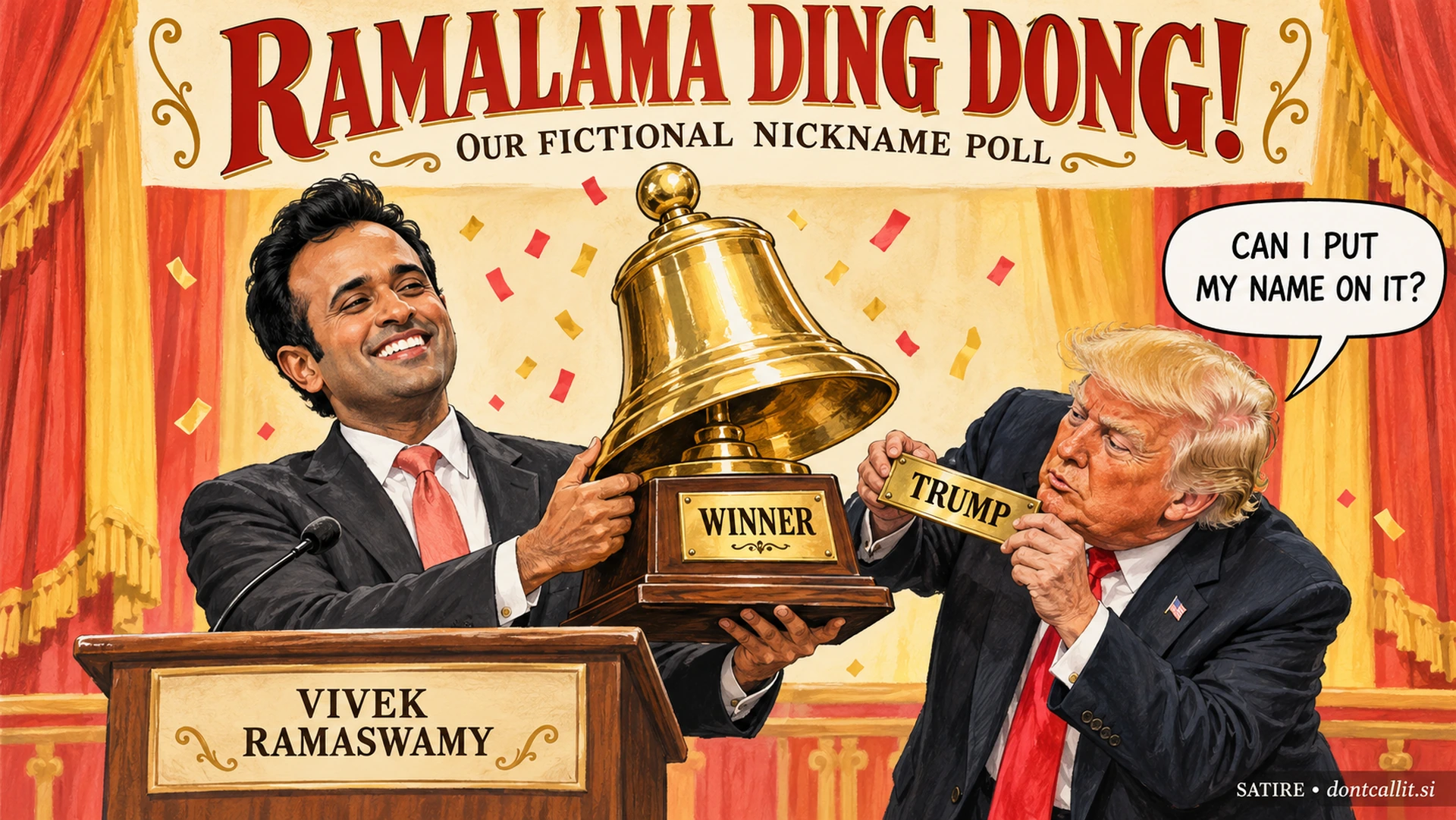
Political satire. The internal poll, committee, and proceedings below are invented.
Don't Call It SI has completed its internal poll to choose a new Vivek Ramaswamy nickname.
After an exhaustive process known as "asking ourselves," the winner, by a clear majority, is:
Ramalama Ding Dong.
We moved quickly. OLD Uncle Orange could announce his own nickname at any moment, followed by a lengthy explanation of how he invented nicknames, how nobody had nicknames before him, and how Ramaswamy now owes him a licensing fee.
Our committee spent 45 minutes debating "Ramalama."
The "Ding Dong" portion passed unanimously before anyone finished reading the motion.
A rigorous selection process
The chair opened the meeting by asking everyone to leave their personal feelings at the door.
There was some confusion about where to put the rest of Ramaswamy's qualifications.
One member proposed "Vivek the Thoughtful." Our legal adviser requested supporting documentation. The nomination was withdrawn during the search.
Another wanted something more dignified.
"We're naming the politician we have available," the chair explained.
The committee briefly considered commissioning a focus group. Unfortunately, the first person contacted asked whether participating meant having to listen to him. Our research director said yes.
We are still recruiting.
The poll itself met our strictest internal standards. Everyone received the same question, nobody had to show photo ID, and the printer was supervised by someone who had never attempted to overthrow anything larger than a paper jam.
A minority report objected that the nickname was childish.
The chair agreed to reconsider if the candidate did.
The campaign requests a correction
In our imaginary follow-up, a campaign representative called to complain.
"You're reducing a serious political figure to a ridiculous nickname."
"We thought you'd appreciate the efficiency."
The representative requested a meeting with someone responsible. We explained that this was a satire operation, so responsibility was shared, disputed, and occasionally blamed on the software.
He asked whether the committee had considered Ramaswamy's message.
"Yes," the chair said. "That's why the vote went so quickly."
The representative then offered to provide a statement explaining what the candidate really meant.
The committee asked whether the statement would arrive before or after the explanation of the previous statement.
He said he would check.
Old Dumpster Fire nearly offers an alternative
Trump has repeatedly called Michigan's Abdul El-Sayed "Mohammed."[5] In our invented naming-office scene, that routine nearly reached a Republican.
OLD Dumpster Fire began workshopping his own contribution:
"Rama Mohammed Lama Ding Dong."
A handler leaned in.
"Sir, Vivek is a Republican."
"Outstanding man. Beautiful name. Wouldn't change a syllable."
The handler added party affiliations to the remaining briefing notes. The president's respect for people's actual names improved immediately.
Old Uncle Orange sends an invoice
The naming office had barely finished celebrating when an entirely fictional representative of OLD Uncle Orange called.
"The president would like to know who authorized a nickname without consulting him."
"We voted."
There was a pause.
"That sounds like something we should challenge."
The representative requested the ballots, the minutes, and the location of the nearest television camera. Our secretary offered the first two.
He lost interest.
Then came the proposed licensing arrangement. All future uses of the nickname would require a payment, a flattering adjective, and a written acknowledgment that nobody in history had been better at naming people.
"What did he contribute to this nickname?" the treasurer asked.
"He made it possible."
The treasurer marked the invoice DISPUTED and asked whether that explanation also covered the national debt.
The appeals process is open
Ramaswamy may appeal the decision.
Applicants must identify the disputed word and supply evidence that the committee has overestimated its relevance.
His imaginary representative asked whether "Ding" and "Dong" could be challenged separately.
"Certainly."
"Could we win on one and lose on the other?"
"Then you'd be Ramalama Ding. We don't think that helps."
A second objection accused the committee of damaging his reputation.
The secretary asked which part of the reputation we had introduced.
The representative requested more time.
We granted an extension, provided he stopped treating every additional minute as an invitation to speak.
At last, the chair announced the final result and asked whether anyone wanted to change their vote.
One member raised a hand.
"I voted for 'Vivek the Thoughtful.'"
"Would you like that entered in the minutes?"
"Absolutely not."
The result stands. Congratulations, Ramalama Ding Dong.
Please check the spelling on your acceptance statement. Our corrections department has already gone home.
The real news behind the nickname
Ramaswamy's campaign produced an ad featuring Amy Acton's estranged mother and announced a $4 million promotional effort.[1] Trump urged him to keep running it, and JD Vance defended it.[2][3] Ohio Gov. Mike DeWine called for its removal while retaining his endorsement of Ramaswamy.[4]
For the fuller record, read Vivek's $4 Million Ad Buy. Decency Sold Separately.. For another trip through the naming department: Trump Discovers Hidden B in Dumb. World Leaders Brace for Impact..
Key Takeaways
- Ramaswamy is the Republican nominee for Ohio governor in 2026.[2]
- His campaign announced a $4 million promotion effort for the ad; that announcement is not an audited final spending total.[1]
- DeWine urged the campaign to remove the ad but kept his endorsement.[4]
Frequently Asked Questions
Who is Vivek Ramaswamy?
He is the Republican nominee for Ohio governor in 2026 and a former 2024 presidential candidate.[2][3]
Why is his Amy Acton ad being criticized?
It uses Acton's estranged mother to attack her account of childhood abuse. Critics object to using that trauma as a campaign tactic.[3]
What has Mike DeWine said about the ad?
He urged Ramaswamy to remove it, calling it "wrong" and "deeply, deeply troubling." He also said his endorsement would remain.[4]
Has the campaign already spent the entire $4 million?
Reporting describes a $4 million promotional commitment for television and online advertising. That figure alone is not an audited total of money already spent.[1]
Receipts
- AP, October 20: Ramaswamy takes responsibility for the ad and announces a $4 million promotion effort
- AP, October 22: Trump backs Ramaswamy's ad
- AP, October 21: Vance defends the ad and criticizes Republican objections
- Statehouse News Bureau, October 22: DeWine objects but retains his endorsement
- The National, October 15: Trump repeatedly calls Abdul El-Sayed "Mohammed"