Donald Trump was discussing the Iran war and higher prices when his Nebraska rally took a detour through Los Angeles and San Diego. By the following day, the White House was explaining why the president's words did not mean what they sounded like. Apparently America First now includes a sentence-repair department. Before we get to the repairs, let's examine what came out of the machine.
The sentence came from him
At the Grand Island rally, Trump said: "Let them take out Los Angeles. Let them take out San Diego." The passage appears around the 12-minute mark in the full speech transcript. He discussed the price of keeping the country safe before naming the cities, then returned to the war ending and fuel costs falling.
We are criticizing something he actually said. No cartoonist supplied the cities, and no political opponent put those words into his mouth. The confusion began at the microphone. The explanation arrived afterward.
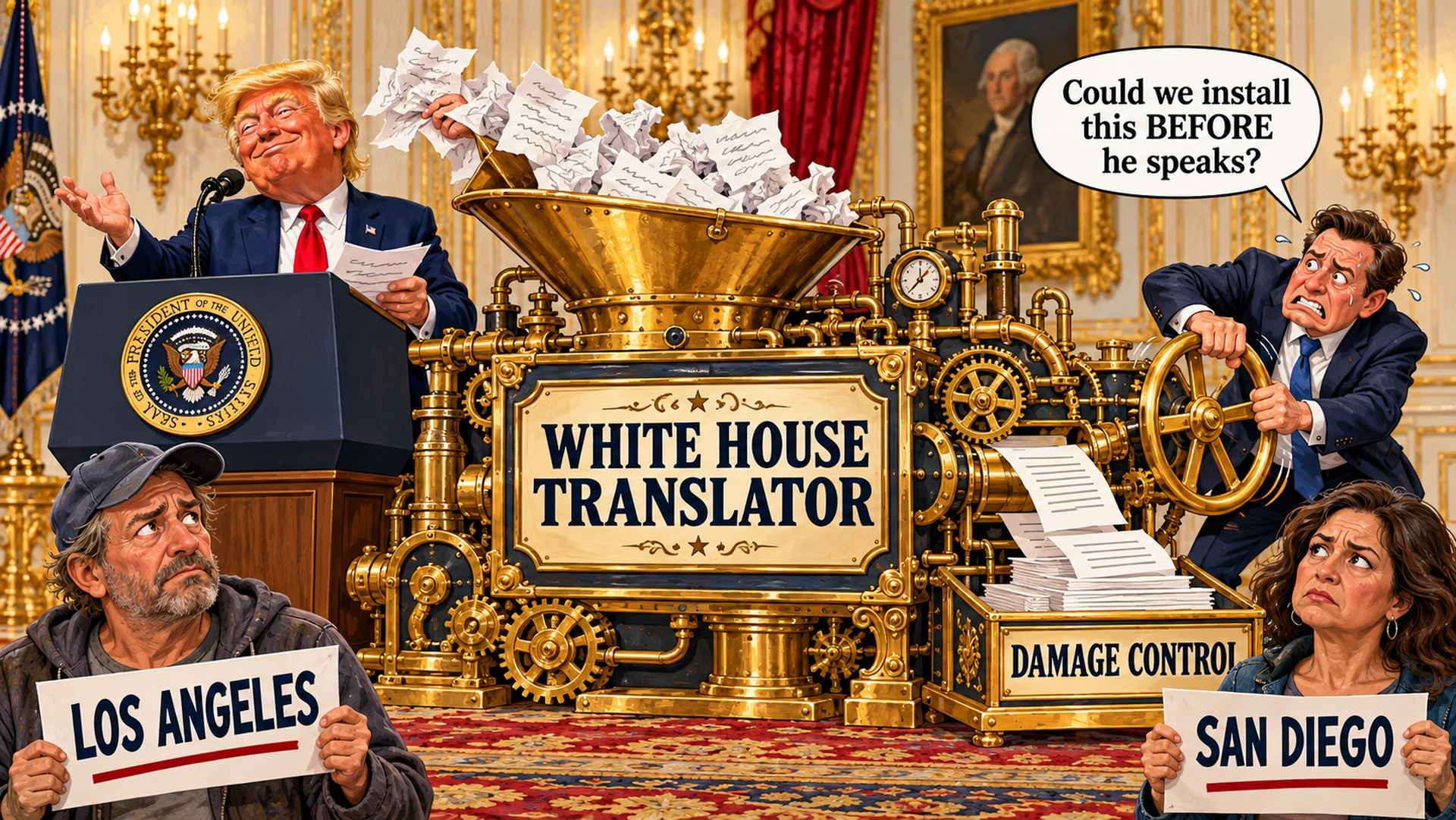
In our fictional sentence-repair shop, two technicians stare at the names of the cities. One asks whether they can replace them with "somewhere else." The supervisor says the president's words must be preserved exactly. They order a larger container of context.
The cleanup has entered the chat
The following day, communications director Steven Cheung said Trump was describing a threat the administration had prevented. He blamed the reaction on a misreading by the media, as AP reported. That is the administration's explanation, and readers should see it.
It is also damage control. That description is our editorial judgment about the response, not proof of a secret motive. His spokesman had to rebuild an argument whose original wording had already alarmed the people it supposedly reassured.
The finished product is familiar: Trump talks, a controversy follows, and an aide arrives with the presidential decoder ring. The audience is then instructed to grade the rewritten version. Wonderful service. Does it come with same-day delivery for the next speech?
Context belongs here. So does responsibility.
FactCheck.org examined the broader passage and similar earlier remarks. Its conclusion is that Trump was likely defending higher fuel prices as a cost of preventing a nuclear threat, rather than welcoming an attack on American cities. PolitiFact also presents the surrounding speech and the White House response. That context belongs on the page.
Acknowledging the likely argument does not require calling the delivery acceptable. A president can intend to reassure people and still communicate recklessly. Public responsibility covers the words he chooses, not just the charitable reconstruction his staff produces later.
We do not need to claim Trump privately wanted those cities destroyed. The public performance gives us enough to work with: an argument about protecting Americans that came out sounding like two cities were available for sacrifice.
The applause made it uglier
FactCheck.org notes that some people in the crowd cheered during the references to the cities. It also notes that Trump did not appear to encourage that response. The record cannot tell us what every cheering person understood, so we will not pretend it can.
At our invented applause rehearsal, the crowd is told to wait until the sentence makes sense. Nobody knows what to do with their hands. The usher checks the schedule, announces that meaning has been delayed, and authorizes provisional clapping. A press aide starts looking for a way to blame the microphone.
The objections also crossed party lines. Reuters reported that Republican congressional candidate Jim Desmond rejected the remarks and stressed the duty to protect Americans. That is a reasonable standard for anyone seeking office: American cities are communities to defend, not props in a rally performance.
America First needs fewer translators
Our Fake News article examines how criticism gets turned into an attack on the messenger. This episode supplies another useful example: the president creates the confusing sentence, then the communications operation faults people for hearing it badly.
Our coverage of disaster-relief rhetoric asks who gets protected when public service becomes campaign material. Here, the basic standard is even simpler. Speak about the safety of American communities with care, regardless of how they vote.
Back in the fictional repair shop, an aide asks whether the next national-security statement can arrive with its meaning already installed. The technician says that is the premium package. Donald orders the gold lectern instead. The overnight crew is told to keep its phones on.
Key Takeaways
- Trump's October 5 remarks included language about letting Iran attack Los Angeles and San Diego. The words are in the speech record.
- The White House said he meant the war was preventing that danger. FactCheck.org considers that the more plausible reading in context.
- That explanation does not erase the alarming wording, the audience response, or the president's responsibility to communicate clearly.
Frequently Asked Questions
Did Trump actually name Los Angeles and San Diego?
Yes. He named both cities during the October 5, 2026, rally in Grand Island, Nebraska. The references appear in the full speech transcript.
Did the remarks prove he wanted Iran to attack those cities?
No. FactCheck.org reads the broader passage as a defense of higher fuel prices to prevent an Iranian nuclear threat. This article criticizes his wording and the subsequent response, without claiming knowledge of his private intent.
What did the White House say afterward?
Communications director Steven Cheung said Trump was explaining a danger the administration had prevented and that the media had misinterpreted him. This article treats that explanation as part of the record and describes the response as damage control.
Is the translator machine a real White House device?
No. The machine, residents, aide, and dialogue in our illustration are invented satire. They represent the effort to explain the president's remarks afterward.
Receipts
Research checked October 7, 2026. The sources document the speech, its context, and the public response. Descriptions of damage control, reckless delivery, and the translation department are editorial judgments or satire. The cartoon depicts an invented scene and invented dialogue.