Your roof blows off. Your town floods. You ask for federal disaster relief. The president asks whether his guy won. Welcome to the imaginary Trump Rewards desk, where a damaged road is a campaign prop and public money comes with a loyalty card.
The roof is gone. Please present your loyalty card.
At the September 16, 2026, Gastonia rally, Trump discussed additional FEMA money for North Carolina and Republican Senate candidate Michael Whatley. The Factbase transcript places the exchange at 00:30:21-00:30:47:
"Now, if Michael loses, I'm not sending it. Okay. No, I'm only kidding."
He immediately assured the audience the money was coming. The Rev transcript at 32:00 also preserves that sequence. Both the conditional threat and the retraction belong in the record. Leaving either out would turn a receipt into a campaign edit.
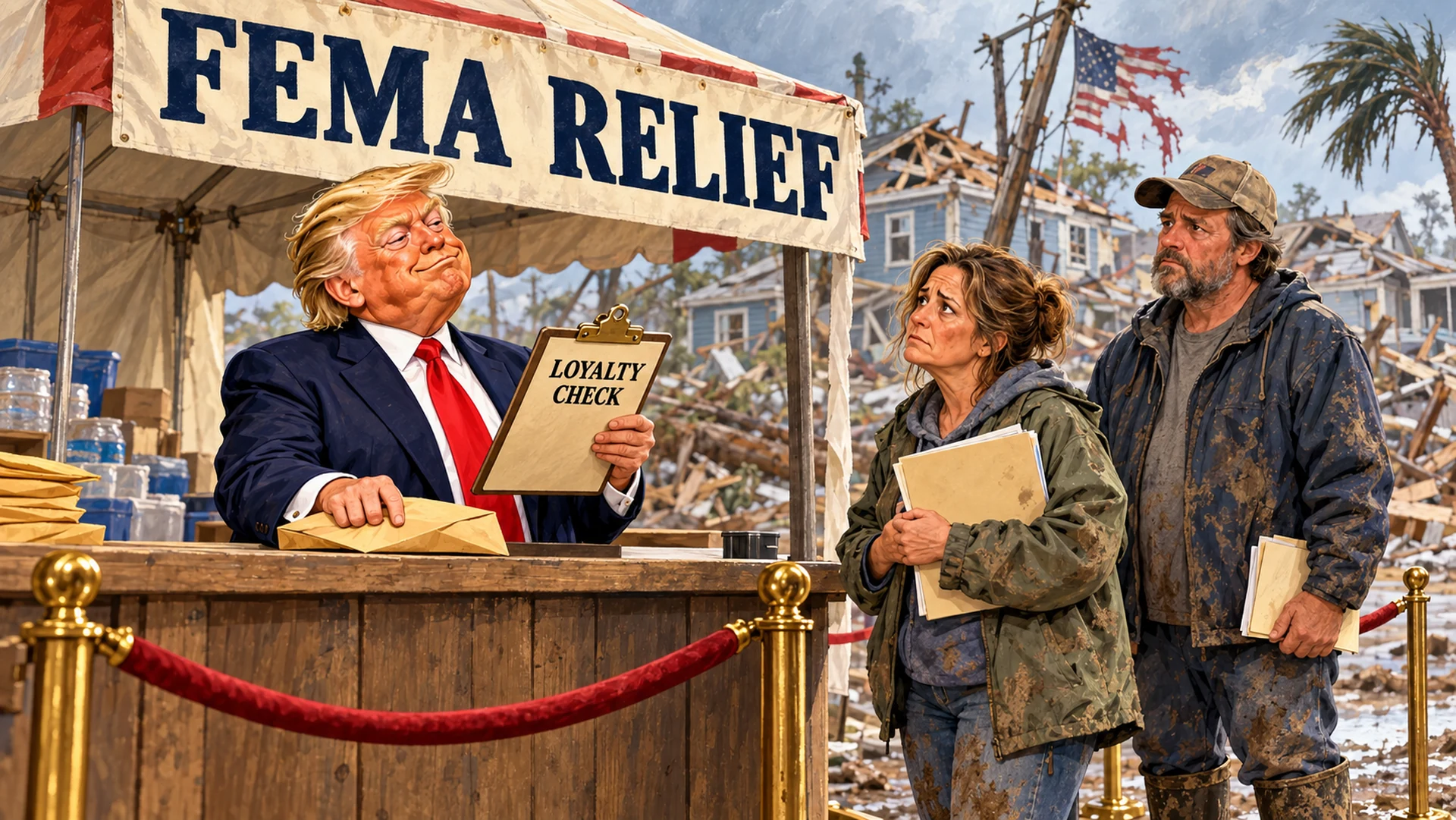
At our imaginary relief desk, the clerk asks for a damage estimate and the name of the winning candidate. The homeowner has only brought photographs of the missing roof. The clerk offers an envelope so he can mail in the remaining half of the application. The homeowner points out that the mailbox is also missing.
Trumpet Baby has found another place to install a velvet rope. This time it is between the taxpayers and their own disaster relief. The imaginary VIP package includes a dry road, a functioning culvert, and the privilege of hearing that the man at the counter was just kidding.
Ohio: apparently, public service has a friends list.
At the October 3 rally in Vandalia, Ohio, Trump discussed disaster assistance and Republican officials' requests for money, then contrasted his relationship with Democratic gubernatorial candidate Amy Acton. At 01:18:31-01:18:47 in the full speech transcript, he said: "But I'm not gonna help her probably."
That is a broader remark about helping a potential Democratic governor; it does not identify a particular benefit that would be canceled. It nevertheless puts the same ugly idea onstage: the president's willingness to assist may depend on the party and personal relationship of the person asking.
In our fictional governors' handbook, the emergency request begins with a box marked "How tremendous is Donald?" The governor asks whether a flood measurement will do. The clerk says numbers are welcome, provided they refer to the size of the victory. The river has inconveniently failed to bring a campaign manager.
Two documented appearances are enough to examine this rhetoric. They are not enough to declare that an identical threat appears in every stump speech. Keep the pattern honest, and the criticism gets stronger.
The "just kidding" does not delete the first sentence.
A retraction matters. It prevents us from honestly presenting the Gastonia exchange as an unqualified announcement that aid would be withheld. It does not require everyone to pretend the first sentence was never spoken.
Back at the invented Trump Rewards counter, a man says his bridge washed away. The clerk asks whether he has considered naming the replacement after Donald. The man asks whether that gets it rebuilt. The clerk says no, but it considerably improves the mood of the conversation.
If the intended reassurance is that he would never do such a thing, he could skip the threat and announce the assistance. Apparently that version does not produce enough applause.
Yes, preserve the transcripts. No, the clip is not a verdict.
The legal concern has real statutory context. 18 U.S.C. § 594 prohibits intimidation, threats, or coercion intended to interfere with a person's voting choices in federal elections. 18 U.S.C. § 598 addresses using specified federal relief appropriations or appropriations authority to interfere with or coerce voting. Those provisions are relevant questions for lawyers, not an automatic finding that this speech satisfies every element of an offense.
A full, authenticated recording and transcript could help examine what was said, its context, and evidence of intent. Any claim would also depend on the applicable law, the challenged conduct, and evidence such as actual funding decisions. Preserve the date, place, full exchange, and source video. Include the retraction. Courts need a record, not an especially satisfying caption.
There is a separate example of judges examining election-related funding conditions. Reuters reported on September 28 that U.S. District Judge Amir Ali blocked DHS from withholding 20% of roughly $1.1 billion in counterterrorism grants over election-administration requirements. The ruling concerned FEMA's statutory authority to impose those conditions. It was not a ruling on the Gastonia or Ohio speeches, or a criminal verdict against Trump.
Public money is governed by law. The campaign stage does not turn it into the president's personal rewards balance. Even the grandest gold counter still has to operate inside the building's rules.
Keep the healthcare claim out until the receipt turns up.
The quoted exchanges above do not establish the additional claim that Trump threatened to withdraw Medicare or Medicaid if voters elect Democrats. We have not verified that claim for this article. If a separate recording establishes it, that deserves its own dated, contextualized receipt.
There is already enough to criticize without upgrading a supported FEMA exchange into an unsupported medical-benefits threat. The same standard runs through our Trump record: keep convictions, court findings, recorded conduct, proposals, and allegations in their proper places.
Until then, the imaginary FEMA clerk has a simple instruction: process the application. The storm did not ask who won. Neither should the relief desk.
Key takeaways
- In Gastonia on September 16, Trump tied additional North Carolina FEMA funding to Michael Whatley's election result, then immediately said he was kidding and promised the money.
- At his October 3 Ohio rally, Trump described Republicans' access to him and said he probably would not help Democratic gubernatorial candidate Amy Acton.
- The remarks are documented. They do not, by themselves, prove aid was denied, establish a crime, or verify the additional claim about withdrawing Medicare or Medicaid.
Questions before the applause
Did Trump actually say FEMA money depended on Whatley winning?
He made that conditional statement in Gastonia on September 16, then immediately said he was kidding and promised the money. This article includes both parts.
Does this prove anyone's disaster aid was denied?
No. These remarks establish what Trump said. Establishing an actual denial or unlawful funding condition would require additional evidence about the government's actions.
Did these speeches establish a threat to take away Medicare or Medicaid?
The cited exchanges do not establish that claim. We have not verified a separate healthcare-benefits threat for this article.
Could the transcripts matter in litigation?
Potentially. Authenticated recordings and complete transcripts may help establish context and intent. Their legal weight depends on the claim, applicable law, and other evidence; they do not guarantee a successful case.
Receipts
Checked October 5, 2026. The full exchanges and source clocks are listed below. This article combines documented remarks with editorial opinion and an invented cartoon; it does not report a completed partisan denial of disaster aid.
- September 16 Gastonia speech: Factbase/Roll Call, 00:30:21-00:30:47
- Same Gastonia exchange: Rev, 32:00 (different recording clock)
- October 3 Ohio speech: Trump Archive, 01:18:31-01:18:47
- U.S. House Office of the Law Revision Counsel: 18 U.S.C. § 594
- U.S. House Office of the Law Revision Counsel: 18 U.S.C. § 598
- Separate grant-conditions ruling: Reuters via Maryland Daily Record, September 28, 2026
Original AI-created editorial cartoon. The relief counter, loyalty clipboard, and people in the scene are invented satire, not a photograph of an actual funding decision.