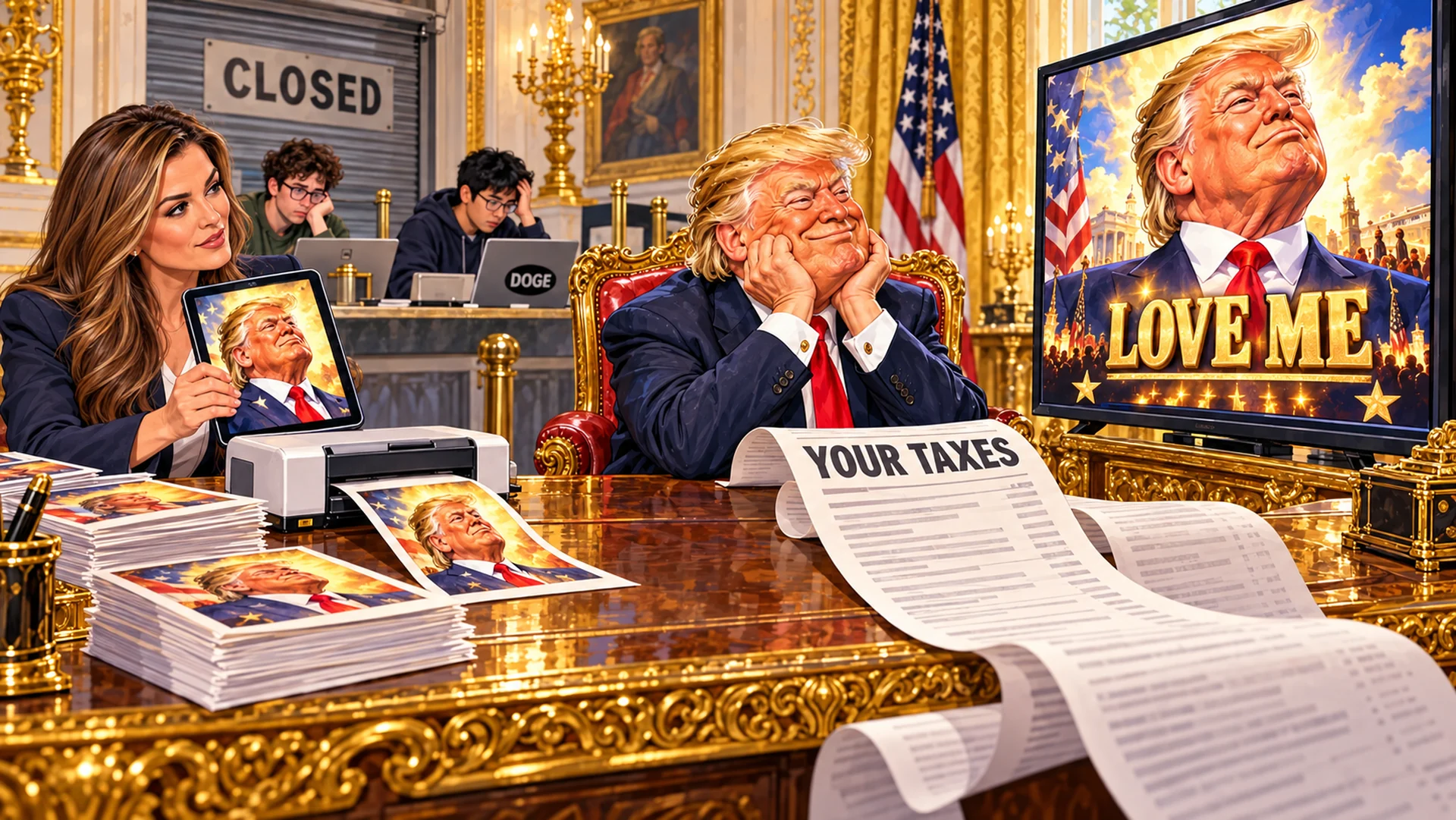
The service counter needs fewer people. The president needs more compliments. That is our reading of the priorities on display around Natalie Harp, the taxpayer-funded Trump ads, and DOGE's assault on the federal workforce. The praise arrives on a tablet, the cuts arrive through the machinery of government, and the bill arrives at your house. Trumpty Dumpty gets another flattering close-up. Everybody else gets hold music.
The meeting needed campaign decisions. He wanted the highlight reel.
The Independent's October 4 report, citing The New York Times describes an August 7 meeting about spending political money on Republican candidates. Trump asked Harp to display flattering White House videos, including Dana White praising him. The attention shifted to promoting Trump himself.
That is a wonderfully ugly little scene: people arrive to discuss what their candidates need, and the president reaches for the remote control to his own greatness. Somewhere in the imaginary meeting minutes, "competitive races" becomes "competitive angles of my face."
Harp's reported role matters. So does the person asking her to perform it. Calling her the mastermind of the entire government ad operation would go beyond this account. It would also let Trump escape responsibility for a choice the reporting attributes to him. He is the president, not a decorative orange paperweight somebody accidentally left near the nuclear codes.
The playlist has a gatekeeper.
In CNN's August 18 reporting, Kristen Holmes described Harp as a route through which allies and lawmakers send material to Trump. She supplies printed articles and messages, often positive coverage. Holmes also reported concerns from sources about Harp's direct line to him outside the usual staff hierarchy.
Access to the president is power. Selecting what he reads, which complaint reaches him, and which compliment is waiting when he looks up can influence the conversation before a policy adviser enters it. That is an observation about information control, not proof that Harp dictates every decision.
In our fictional briefing kitchen, the president has ordered himself again. The starter is a flattering clip, the main course is a longer flattering clip, and dessert is Dana White saying how tremendous the meal is. An aide tries to serve a fact. Donald sends it back. He did not order anything bitter.
This fits the larger problem in our fake-news article: flattering material gets a welcoming chair, while scrutiny gets an insult. You can run a fan club on that arrangement. Running a country requires hearing things that do not improve the host's mood.
Who pulled the financial lever? Follow the officials.
The Times account reprinted by the Anderson Valley Advertiser says Trump directed budget chief Russell Vought to find government money. It reports that OMB counsel Mark Paoletta and White House counsel Will Scharf supported using DHS funds, and that Trump and chief of staff Susie Wiles discussed the ads with DHS secretary Markwayne Mullin.
Those are reported accounts of decisions and advice, not a judicial finding that the spending was lawful or unlawful. They also describe a considerably bigger apparatus than one assistant with an iPad.
ABC News traced the records on September 29: CBP money was moved on September 19 into a category for commemorative events. A $20 million national media contract went to Maryland agency LMD the next day. ABC cited an AdImpact estimate of at least $1.7 million in airtime by then.
The later Times report put the estimated airtime total at about $5.5 million. Both estimates are dated snapshots. The $20 million contract is a separate figure; treating every committed dollar as money already spent would inflate the receipt.
The sequence deserves scrutiny: presidential demand, official funding arrangements, contractor, television. The public should be able to inspect the authorizations, scope, invoices, and deliverables. "Everybody knows he loves television" is a character note. It is a terrible appropriation policy.
We covered the original spending controversy in Your tax dollars bought the commercial. The Harp reporting adds a view inside the praise presentation. It does not replace the need to follow the money.
The defense is "public service." The public can ask: what service?
The White House says the ads are patriotic public service announcements. ABC reported that defense alongside the spending records. The Times account says officials emphasized the absence of an instruction to vote for a candidate. DHS told that report its contracting decisions followed applicable law.
On September 29, Senators Patty Murray and Chris Murphy demanded the contracts and an explanation from DHS, alleging an improper use of public money. Their letter is a documented oversight challenge. It is not a completed GAO investigation, a criminal conviction, or a final court ruling.
The editorial question survives the procedural caution. What useful thing does a viewer learn from the president's glory reel? How to apply for a benefit? Where to get disaster assistance? Which actual government service has changed? If the principal takeaway is that Donald Trump would like applause, his public relations team has successfully located an expense the public never needed.
Our imaginary production team has three instructions: keep Donald in frame, keep Donald happy, and bill somebody who is not Donald. An editor asks where the public service goes. The producer points to the invoice. "There. The public is servicing that."
DOGE's young staff were real. So were the adults above them.
WIRED's February 2, 2025 investigation identified six young engineers, apparently aged 19 to 24, with little or no government experience. One was a Harvard senior. It reported that one young staffer joined GSA calls where employees justified their work. This was a subset of DOGE, not its entire workforce.
In our fictional efficiency workshop, the new recruit demonstrates how quickly he can delete a department. The veteran asks who will do its work. The recruit opens a fresh tab. The veteran asks who understands the law it administers. The recruit opens another tab. By lunchtime, the browser is fully staffed.
Trump's January 20, 2025 order created the DOGE structure and called for agency teams with leadership, engineering, human resources, and legal roles. It directed broad access to unclassified agency records and systems, subject to law.
His February 11 order assigned agency heads responsibility for preparing large reductions in force and directed them to consult DOGE team leads on hiring. The order contemplated closing or consolidating some functions. It did not make every young engineer the legal authority for every firing.
That formal chain is part of the indictment of the judgment involved. Senior officials built the arrangement, accepted its interventions, and implemented decisions. The inexperienced staff did not parachute into federal systems while the White House slept. The president's signature helped open the door.
Blaming everything on "college kids" risks shrinking a government-wide political project into a dorm-room prank. The people with titles, lawyers, budget authority, and years of experience were there too. They should not get to stand behind a young employee when the consequences turn up.
Efficiency should be measured after something breaks.
In April 2025, Reuters documented a laboratory purchasing bottleneck: approval for a roughly $200 dry-ice order took a month. A colleague's workaround added about $100 in shipping. The report connected procurement restrictions to disruption; CDC did not answer its questions.
In our fictional laboratory, the dry ice request has finally been approved. The specimens are delighted to hear it, although they have now been warm long enough to request separate offices. Procurement congratulates itself on a thorough review.
On April 3, Reuters reported error-filled USAID termination notices that sources said threatened correct pension and severance calculations. Human resources staff who had been put on leave were brought back to fix the notices. State did not immediately comment. Reuters could not establish how many notices were wrong.
Put the specialists out of the way, rush the supposedly simple paperwork, then ask the specialists to repair it. That is the institutional version of throwing away the instruction manual and billing your neighbor for assembly.
Closing a building also needs precise wording. Reuters's March 3, 2025 report described planned SEC lease terminations in Los Angeles and Philadelphia. The agency's email said that did not directly imply layoffs or reorganization. A terminated lease, a relocated office, and an abolished service are different events. A savings list should show the follow-through, not merely the announcement.
The cleanup was still a live issue in 2026.
The consequences are not confined to early DOGE headlines. The State Department inspector general's July 2026 evaluation examined foreign-assistance work transferred from USAID. It described staffing, training, system-access, and guidance problems. Seventeen bureaus and offices had inherited 1,504 awards, with $51.5 billion already obligated.
The watchdog said earlier workforce and resource recommendations had not been fully implemented by July 2026. The department's management office said implementation was in progress. The evaluation issued no new recommendations; it urged completion of the existing ones.
Back at our invented service counter, one employee is answering the phone, fixing the computer, and explaining why the phone was classified as redundant. The manager asks whether the reorganization is working. The employee asks which job the manager would like interrupted for the answer.
A public institution is a set of obligations to real people. Its staff often carry knowledge about exceptions, deadlines, suppliers, and legal requirements that will not appear in a quick spreadsheet export. Discarding that knowledge can create costs long after the celebratory post has scrolled away.
The DOGE sign came down. The mission found other desks.
Keep the timeline straight. Reuters reported in November 2025 that DOGE no longer operated as a centralized entity, quoting OPM director Scott Kupor. OPM had absorbed many functions, and staff had moved into other roles. That does not mean every associated policy or authority disappeared.
The following day, Reuters reported that Kupor and Vought were working to institutionalize DOGE's mission. This is the institutional connection to Vought, who the new ad reporting says was also tasked with finding money for Trump's promotion. It is not evidence that Harp directed DOGE cuts.
Our argument concerns priorities: the administration that championed cutting the machinery of public service also arranged public funding for presidential self-promotion. These are separate actions inside the same administration. Put them beside one another and ask which expense had to justify its existence.
The fictional reorganization has also reached the complaints desk. It now reports to the department it was created to investigate. The manager calls this streamlined communication. The complaint is forwarded directly to the wastebasket, eliminating two meetings.
Off script: the destination keeps looking like him.
There is no need to claim he literally goes off script every time. The August meeting supplies one example of a practical discussion turning toward his own image. Another is in CNN's June 24, 2026 interview with Maggie Haberman and Jonathan Swan.
The reporters described asking Trump about presidential power during their own Oval Office interview. He had Harp fetch two flattering printouts comparing his power with famous historical rulers. They said the writer was a former Gary Player caddie and business associate, rather than the historian Trump described.
The striking part is the substitution. A question about the office's power becomes an opportunity to distribute a testimonial about the officeholder's magnitude. Harp retrieves the material. Trump directs the retrieval. The point is the reported behavior, not a diagnosis of either person.
The pattern predates this year. Reuters's October 27, 2024 campaign account described digressions while advisers sought a policy focus. Trump called his style the "weave"; his spokesperson defended it as effective policy storytelling.
Our reading: the danger is not simply that a speech wanders. It is that everyone around the speaker must decide whether to redirect him, indulge him, or turn the detour into an official product. When indulgence becomes a purchase order, the cost travels well beyond the room.
At our imaginary policy meeting, the agenda has five items: Donald, more Donald, the previous item in slow motion, lunch with somebody who admires Donald, and other business. Other business has been postponed. It was getting political.
Who is pulling the strings? Name the hands you can document.
The record gives us different kinds of power: Harp's access and information supply; Trump's preferences and instructions; Vought's budget role; legal advice; agency contracting; and the operational roles created around DOGE. Those distinctions make responsibility easier to locate.
A single secret-controller story makes the system feel easier to understand. It can also become an escape hatch for the president and every senior official who implemented what he wanted. Aides can influence him while he remains responsible for exercising the office.
In the imaginary scheduling office, two requests arrive together. One asks to restore a public service. The other asks for a slower dissolve between two shots of Donald. The first is sent for a cost-benefit analysis. The second gets a production meeting, three revisions, and a bigger screen.
Nobody voted to hire a national compliment dispenser. Nobody should have to lose an experienced public servant so government can discover a new way to televise the boss's favorite face. Before another office has to explain why it needs people, the praise machine should explain why it needs public money.
Trumpty Dumpty may enjoy the flattering picture. The people holding the tablet, moving the money, signing the orders, and closing the shutters still owe the country an answer.
Key takeaways
- The new reporting puts Harp in the praise presentation and Trump in the driver's seat. It does not establish a secret puppet master.
- The ad campaign has a $20 million government contract. That figure is a commitment, not proof that the entire amount has already been spent.
- DOGE placed unusually inexperienced young staff close to consequential decisions. Trump's orders also assigned responsibilities to agency heads; the adults who authorized the system remain accountable.
Questions before the applause
Does the reporting establish that Natalie Harp controls Trump?
No. It documents her access, information role, and participation in a praise presentation at his request. It also attributes the demand for government-funded promotion to Trump himself.
Were all DOGE staff college students with independent firing power?
No. WIRED identified a young subset. Trump's workforce order assigned agency heads formal responsibilities, with DOGE involvement. Operational influence and legal authority are related but distinct.
Had the full $20 million ad budget already been spent?
The contract figure does not establish that. Published airtime estimates were lower, dated snapshots; actual spending requires invoices and expenditure records.
Was DOGE still a centralized organization in October 2026?
Reuters reported its centralized operation had ended in November 2025. Functions and personnel continued elsewhere, and officials described institutionalizing its mission. The article dates those developments separately.
Receipts
Checked October 5, 2026. Reporting, official documents, oversight findings, and editorial judgments are identified in the text. The ad spending estimates are dated, and allegations of improper spending are not presented as final legal findings. The cartoon is an invented scene combining the 2026 praise story with the 2025 DOGE cuts.
- Harp's role in the August meeting: The Independent, October 4, 2026
- Trump, Vought, legal advice, and updated ad estimates: NYT report reprinted by AVA, October 4, 2026
- Contract records, CBP funds, and White House defense: ABC News, September 29, 2026
- Primary oversight letter: Senate Appropriations minority, September 29, 2026
- Harp's information and access role: CNN transcript, August 18, 2026
- Reporters describe their Oval Office interview: CNN transcript, June 24, 2026
- Six young engineers and their access: WIRED, February 2, 2025
- Primary DOGE organization order: White House, January 20, 2025
- Primary workforce reduction order: White House, February 11, 2025
- Purchasing restrictions and operational disruption: Reuters via Investing.com, April 24, 2025
- USAID termination notice errors: Reuters via Fast Company, April 3, 2025
- Primary oversight evaluation, AUD-FA-26-17: State Department OIG, July 2026
- Planned SEC lease terminations and agency explanation: Reuters, March 3, 2025
- End of centralized DOGE operation: Reuters, November 23, 2025
- Kupor, Vought, and institutionalizing the mission: Reuters, November 24, 2025
- Digressions and the campaign's response: Reuters, October 27, 2024
Original AI-created painted satire: Harp supplies flattering material, Trump admires his television image, and fictional adult DOGE engineers work beside a closed service counter. Invented composite scene; it does not depict an actual meeting or allege that Harp directed DOGE cuts.