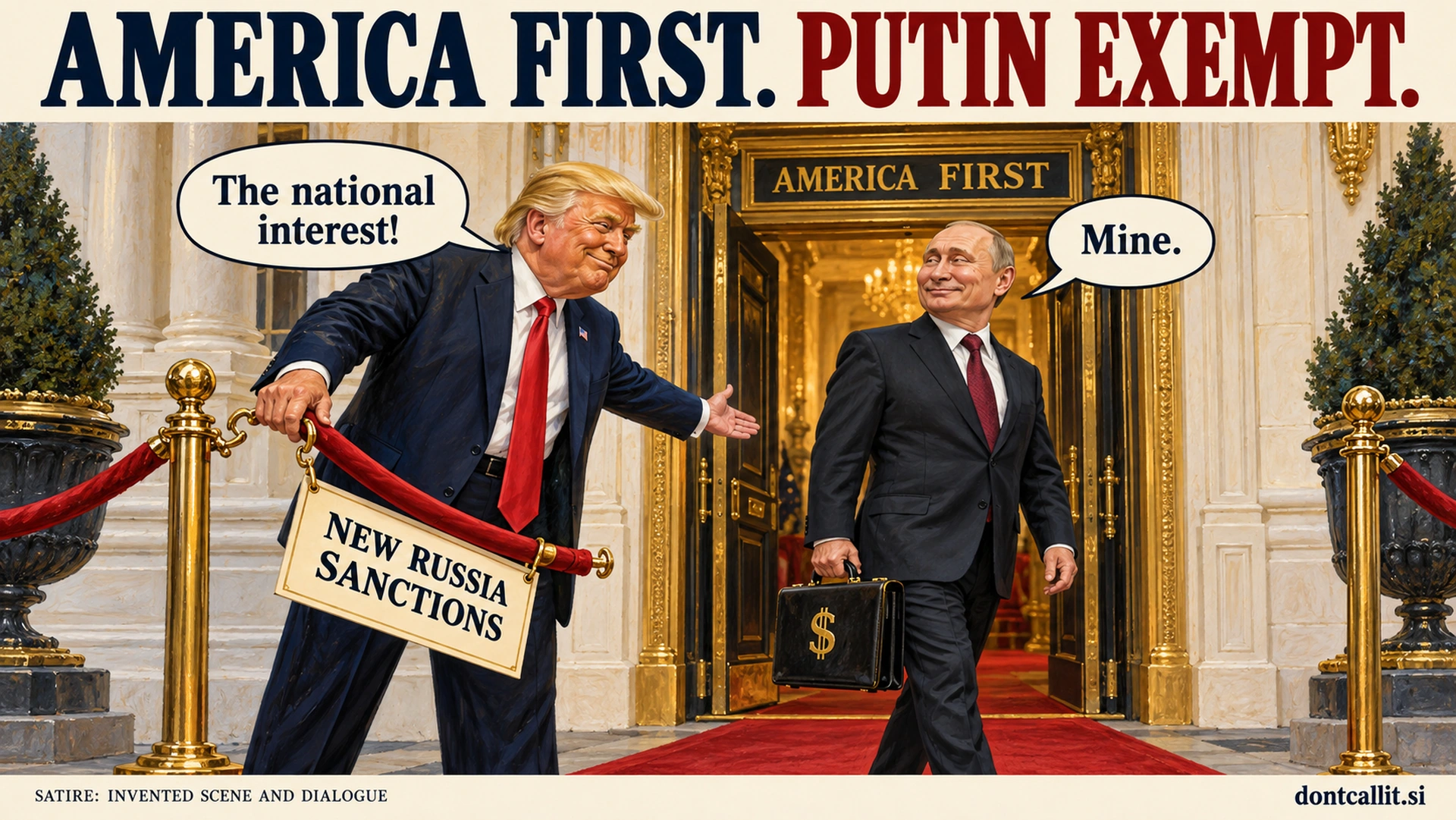
Donald Trump has found a way to make sanctions painless: waive the new ones before Vladimir Putin has to endure them. Finally, a government service delivered ahead of schedule. Unfortunately, the satisfied customer is in the Kremlin.
Three Key Takeaways
- Trump waived major measures under the new Graham Act. Earlier executive-order sanctions remain in place.
- Republican and Democratic senators had already condemned his separate Russian diesel deal.
- The backlash now includes a conservative call for Congress to investigate his help to Putin.
Tough on Russia. Offer void in Russia.
Trump signed the Graham Act on September 18; his October 16 order waived its major measures before October 18. The law authorized waivers.
He signed the punishment. He signed the escape hatch. Somewhere, a Sharpie is requesting conscientious-objector status.
Imagine buying a burglar alarm, posing for photographs with the installer, and then giving the burglar the code because you have a very good relationship. When the neighbors ask what happened, you tell them the house has never been safer. The burglar agrees. He is standing in your kitchen.
For a man who treats tariffs like hot sauce, Donald gets surprisingly delicate when the menu reaches Moscow. Suddenly the economic pressure needs a little rest. A warm blanket. Perhaps Vladimir could recommend a suitable pillow.
The national interest. Please specify nation.
The order invokes U.S. national interests and preserves older executive-order sanctions.
Keeping some old pressure while waiving the new pressure is still a choice. If the fire department arrives, admires your burning garage, and decides against using its new hose, you do not have to applaud because it left the old bucket in place.
The administration can explain the American benefit in plain English. What did Putin give up? What changed in Russia's conduct? What makes this the moment to ease pressure? Those are questions for documents and sworn testimony, which is unfortunate for an administration that would prefer a standing ovation.
"Trust me" is a poor substitute for an answer. Especially when the proposed beneficiary has his own intelligence services.
Sixty more days of very serious looking
Reuters reported on October 18 that Marco Rubio said Trump could take up to 60 days to assess the sanctions and tariffs. Rubio cited the potential effects on the U.S. and global economies, including countries that buy Russian energy. The executive order gives its waivers no fixed end date.
Washington has an impressive selection of clocks. There is the emergency clock, which runs extremely fast when Donald wants something. Then there is the accountability clock, which is being repaired by a contractor who cannot be reached.
Putin gets relief while everyone studies whether Putin should get relief. In most businesses, you evaluate the customer before issuing the refund. Donald apparently prefers to send the money and wait for a review.
Five stars from Moscow. Ukraine would like to speak to a human being.
The treason word has entered the chat
National Review's Andrew C. McCarthy called for Congress to investigate Trump's "aid and comfort" to Putin. The Daily Beast described his criticism as a treason accusation.
When the conservative magazine starts sounding the alarm, the White House may want to retire its usual explanation that a sociology department invented the problem.
Treason has a narrow constitutional definition. An accusation is not a criminal finding. That distinction matters; it also leaves plenty of room for Congress to investigate the decisions, the justifications, and the consequences.
Donald can survive an insult. He manufactures them wholesale. What he should have to survive is a hearing where the follow-up question is still waiting after he changes the subject.
Call it betrayal. Call it appeasement. Ask whether the conduct warrants investigation. The question does not become less serious because the man responsible has arranged his public life like a mattress liquidation commercial.
Congressional spines: some assembly required
On October 13, a bipartisan group of senators, including Republicans Thom Tillis, Susan Collins, Lisa Murkowski, Mitch McConnell, and John Cornyn, urged Trump to reverse the separate diesel arrangement. Their letter said: "This deal is a gift to our adversary and a betrayal of our Allies; it should be rescinded."
Good. Now comes the difficult part: remaining concerned after the press release has finished uploading.
Congress has perfected the ceremonial expression of alarm. Members emerge, discover their principles, make a statement, and return the principles to climate-controlled storage. The next morning, an aide checks them for signs of use.
If lawmakers believe the president is handing Putin a gift, the logical next step is oversight. Get the records. Demand explanations. Hold hearings. Put the administration's claims beside the evidence and keep asking questions until an answer arrives.
We have an entire applause department already. The positions requiring hands have been filled. There may still be an opening for someone with a spine.
A very special relationship. An ordinary bill.
Our previous stop at Vlad's Biggest Fan covered Donald's enthusiasm for the relationship. The sanctions waiver gives that enthusiasm paperwork.
You do not need a secret tape, a lurid theory, or a framed photograph to ask whose interests a public decision serves. Read the order. Read the senators' objections. Ask what America received and why Congress should accept the explanation.
Donald sold himself as the man nobody could push around. Putin seems to have found the customer-service number.
America First. Terms, conditions, and Vladimir apply.
Questions people might actually ask
Did Trump remove every Russia sanction?
No. The October 16 order waives measures under the new Graham Act and expressly preserves earlier executive-order sanctions.
Do the waived measures automatically return after 60 days?
The order sets no fixed expiration. Rubio's reported review period is not an automatic reinstatement date.
Does calling this treason establish that crime?
No. Political accusations and calls for investigation do not establish the constitutional offense. The case for scrutiny can be assessed using the public record.
Receipts
- White House: October 16 executive order, especially Section 4.
- Senator Thom Tillis: October 13 bipartisan letter opposing the separate Russian diesel deal.
- Reuters: Rubio describes a review of up to 60 days, October 18.
- Andrew C. McCarthy, National Review: call for a congressional investigation, October 17.
- Daily Beast coverage.
- National Archives: Constitution, Article III, Section 3.
Political satire and opinion. The accompanying cartoon's scene and dialogue are invented.