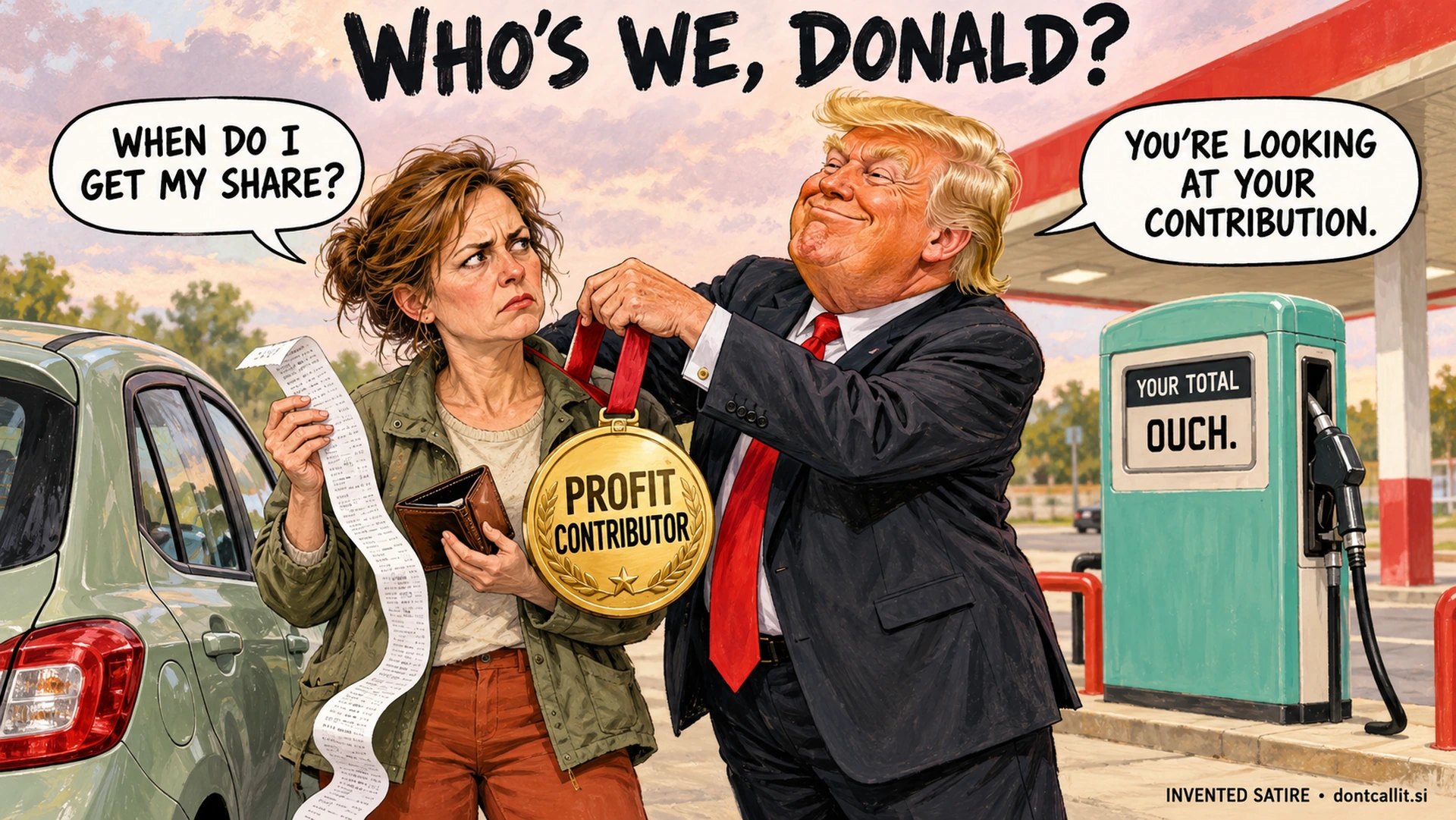
America's doing great. Please stop checking your wallet.
Satire. The celebration, motorists, and dialogue below are invented. The factual record follows the story.
Donald promised the motorists good news.
They made the mistake of assuming it concerned them.
Drivers arrived at the gas station expecting an announcement about relief. Instead, Donald told them the energy business was doing wonderfully and asked everybody to look happier about it.
A man near the front said he was having trouble seeing the improvement from his side of the transaction.
"You have to look at the whole country," Donald explained.
"Which part has the money?"
"The successful part."
"Can I afford to drive there?"
Donald asked an aide whether they could find a more optimistic motorist.
They found a woman who had canceled her family's vacation because of the cost of getting there.
"Less traffic," Donald announced. "We're fixing everything."
A second driver said he had taken another job to afford the commute to his first one.
"Two jobs! Nobody talks about that."
The aide wrote down "employment success" and asked the driver to avoid explaining the order in which it had happened.
Donald continued. The industry was earning tremendous money. Great money. The kind of money that made him want to congratulate the people receiving it, even when he was standing among the people spending it.
"So who's we?" someone asked.
"America."
"I'm in America."
"Then you should be very proud."
"Can I pay with that?"
The cashier confirmed that pride remained unsupported by the card reader.
An aide suggested a customer appreciation program. Donald liked the sound of that. The customers had certainly been doing a lot of appreciating. They could appreciate the oil industry, appreciate the president, and appreciate how much cheaper the same purchase had been before.
The aide quietly crossed out the third option.
A driver asked whether the program offered a discount.
"We're giving you something better," Donald said. "Recognition."
"Does that go in the tank?"
"You people are very focused on yourselves."
The cashier tried to explain that the station was an independent business. She worked there. She did not personally own an oil field, a refinery, or the remarkable fortune being celebrated beside her place of employment.
Donald asked whether she had considered owning an oil field.
"I was hoping to make rent."
"Start small."
The aide wondered whether that advice required a follow-up sentence. Donald had already moved on.
A reporter asked how ordinary households were supposed to experience the prosperity.
Donald pointed to the enormous amount of money changing hands.
The reporter asked whether it mattered whose hands it left and whose hands it reached.
Donald said that was exactly the sort of negativity ruining a perfectly good celebration.
To restore the mood, the staff distributed a survey. It asked customers to rate the economy from Tremendous to Greatest Ever.
One driver wrote "Expensive" in the margin.
The aide explained that this was a satisfaction survey, not an opportunity to introduce new feelings.
Another customer asked when prices would fall.
Donald said soon.
"Before I fill up?"
"You can't rush a tremendous result."
"Can I send you the bill while I wait?"
The aide removed the question period from the program.
Eventually, the drivers returned to their cars. Their bank balances had done their part for the celebration. Donald asked the cameras to capture the smiling people.
The photographer asked which ones.
"The successful part," the first motorist offered.
As he drove away, Donald called after him.
"Next time you fill up, remember who's responsible!"
The driver promised he would.
The aide asked Donald to stop helping.
What actually happened
At his Saturday, October 24, 2026, rally in Perry, Georgia, Trump celebrated money being made by the U.S. oil and gas business. He anticipated criticism about consumers suffering at the pump, then said, "We're making a freaking fortune." He also promised pump prices would come down. The full video and transcript preserve that context. [1]
Business Insider reported the remarks on Sunday, October 25. [2] This article does not treat the rally's large-dollar assertions as an audited industry profit total. Revenue and net profit measure different things. [4]
Key Takeaways
- The remarks were made Saturday, October 24, and reported Sunday, October 25. [1][2]
- Trump praised the oil and gas business's financial performance while acknowledging higher prices and promising a decline. [1]
- Pump prices include crude oil, refining, distribution and marketing, and taxes. A company's sales revenue is also different from its net profit. [3][4]
Questions worth asking
When and where did Trump make the remarks?
At Guardian Centers in Perry, Georgia, on Saturday, October 24, 2026. The video and transcript were published the following day. [1]
What business was he describing when he said the country was making money?
The passage explicitly discusses the U.S. oil and gas business and buyers coming to American producing states. Trump also predicted that high prices would fall. Those are his claims and predictions. [1]
Are oil-company revenues and profits the same thing?
No. Revenue records sales. Net profit accounts for the costs, expenses, and other deductions involved in earning that revenue. The SEC's financial-statement guide explains the distinction. [4]
What determines the price at the pump?
EIA identifies crude oil, refining, distribution and marketing, and taxes as the main components. Local competition and operating costs also affect retail prices. Some stations are independent businesses purchasing fuel for resale. [3]
Receipts
- [1] Tommy Christopher: full video and transcript of Trump's October 24 Georgia rally. Published October 25, 2026. The oil-and-gas passage includes the anticipated criticism and the prediction of falling prices.
- [2] Business Insider: Trump on high gas prices. October 25, 2026, reporting on Saturday's remarks.
- [3] U.S. Energy Information Administration: factors affecting gasoline prices. Official explanation of pump-price components and retail-market differences.
- [4] U.S. Securities and Exchange Commission: financial-statement guide. Official explanation of revenue, costs, and net earnings.
More from the affordability department
The bills still want paying. The foreign-policy sales pitch also has a pump-and-plunder department.