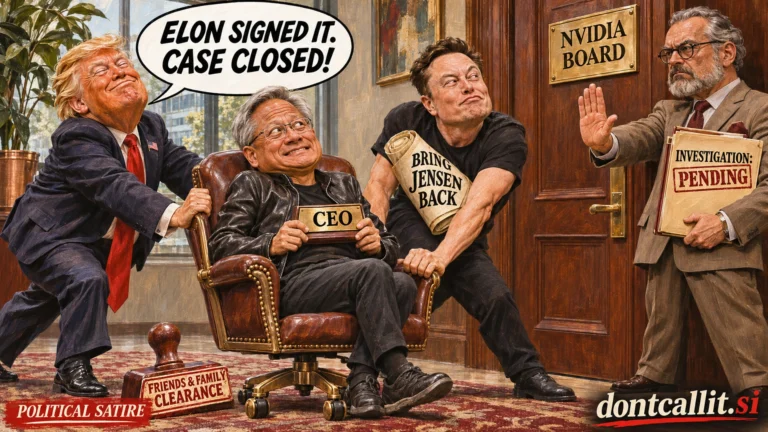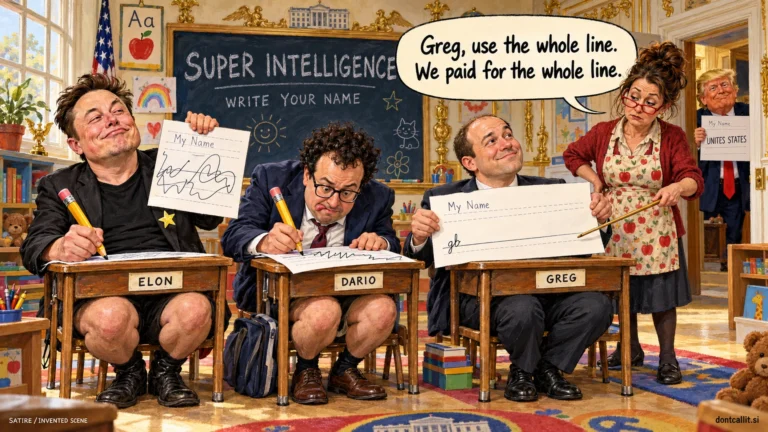
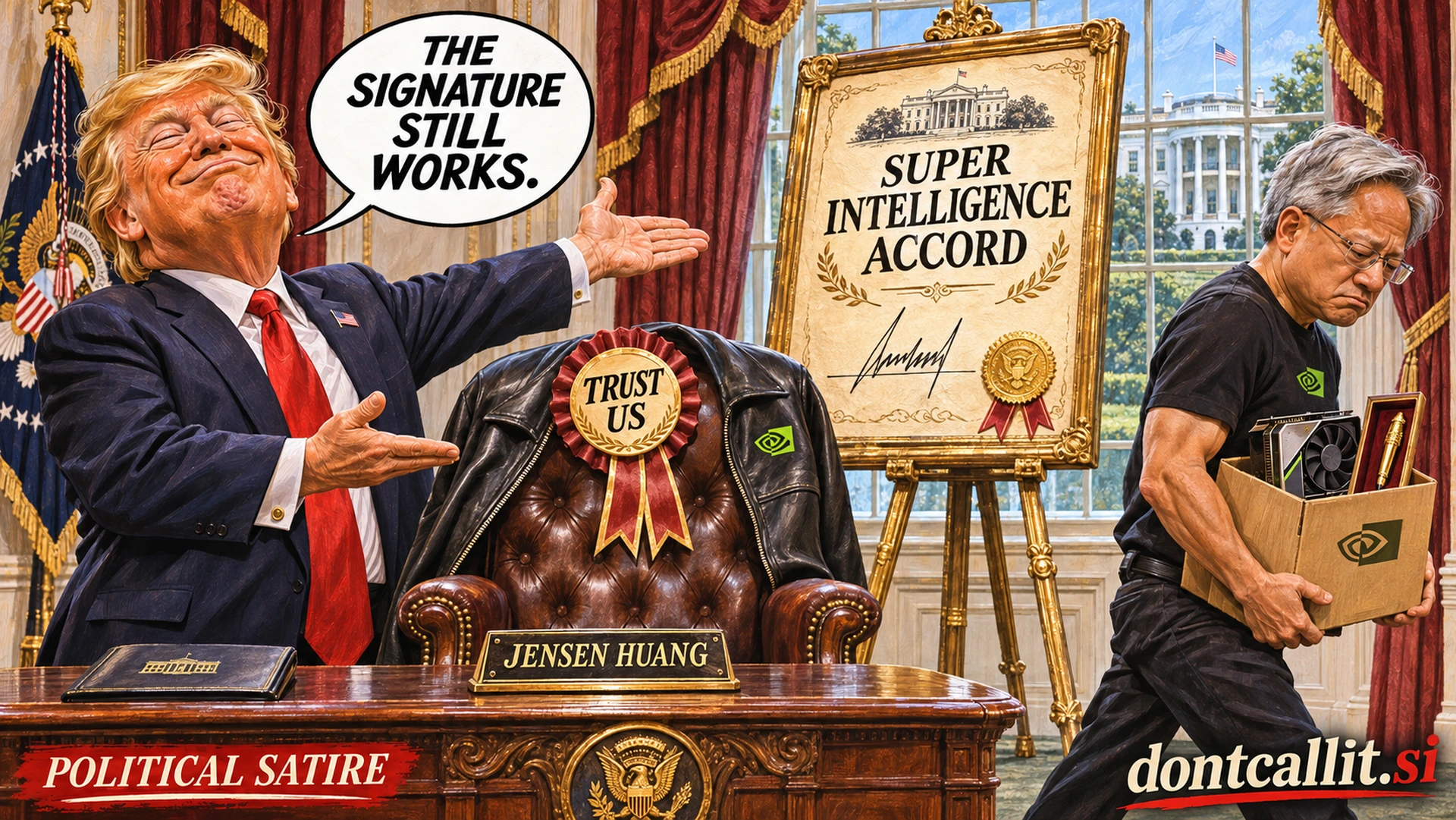
Political satire. The White House meeting, conversations, and administrative procedures below are invented. Jensen Huang's resignation is real. The intelligence allegations remain under investigation.
Donald called an emergency meeting to find out whether Jensen Huang's resignation meant somebody had to buy a new pen.
The White House had already held the ceremony. There were photographs, expensive suits, and a document promising that the people building the future could be trusted to supervise themselves. Nobody had budgeted for one of them leaving before the commemorative stationery ran out.
An aide explained that Nvidia had announced Huang's immediate departure as president, CEO, and board member.
"But he signed the thing," Donald said.
The aide agreed that he had.
"Did anybody tell the board?"
The first proposal was to invite the replacement CEO to a second ceremony. Donald rejected it. A second ceremony would suggest the first ceremony had been insufficient, and the first ceremony had included him.
Instead, staff began drafting a statement explaining that Super Intelligence remained completely stable, apart from the intelligence and several of the people responsible for it.
A lawyer suggested sticking to the facts. Donald asked why the lawyer was taking Nvidia's side.
The problem was the accord itself. It mentioned internal controls, independent assessment, and board oversight. These had sounded excellent when printed on thick paper. Now a board had started doing things, and everyone wanted to know who had authorized that interpretation.
"Jensen signed a commitment to board oversight," the aide said.
"I thought that meant they watched him sign."
Someone was sent to check whether the word "independent" had appeared in the final version. It had. Four people immediately asked who had put it there.
The communications team prepared three possible explanations: accountability was working, accountability was unnecessary, and accountability had been unfairly politicized. Donald approved all three and asked for the shortest one to go on television.
Meanwhile, a junior official made the mistake of asking whether the government's enthusiasm for a technology executive should involve anything beyond liking him at dinner.
He was reassigned to verifying the dinner.
The remaining signers received a reassuring memo. Their commitments remained in force, their photographs remained available, and their names could still be used in speeches about American leadership. They were asked to notify the White House before any future independent oversight became visible to the public.
An updated signing protocol added a new requirement: each participant would confirm that he still held the job printed beneath his name. The confirmation would remain valid until the photographer finished.
Donald suggested extending it to thirty days. Counsel declined to underwrite that.
By late afternoon, the administration had resolved the crisis. The accord would stay exactly as it was. Nobody would revisit the promises, the judgment, or the assumption that a room full of powerful men nodding at each other counted as a safety system.
There would, however, be a new ceremony.
Donald would sign a statement confirming that the previous signing remained a tremendous success. Staff asked who would provide independent oversight.
Donald checked the camera angle.
Key Takeaways
- Nvidia announced on November 12 that Jensen Huang had resigned as president, CEO, and a director, effective immediately. CFO Colette Kress became interim CEO. Nvidia announcement
- Huang is listed among the signers of the September 29 White House Accord on Super Intelligence, which calls for controls, external evaluation, and independent board oversight of frontier-model safety processes. Accord text
- Nvidia opened an independent investigation into reports of a foreign intelligence effort targeting Huang. Its November 8 statement said it had no reason to believe national security or company secrets had been compromised. That statement was not a completed investigation. Nvidia board statement
FAQs
Has Jensen Huang resigned from Nvidia?
Yes. Nvidia's November 12 announcement says he left the presidency, chief executive position, and board immediately. Colette Kress is serving as interim CEO while retaining her CFO role. Nvidia announcement
Does his departure remove his name from the SI accord?
The archived September 29 document still lists Huang for Nvidia. Leaving his company position does not change who signed that historical document. His resignation should not be described as a withdrawal from the accord without separate evidence. Accord text
What oversight does the accord actually propose?
It sets out four layers for frontier-model safety: internal controls, an internal monitoring team, independent external assessment, and an independent board committee. These commitments concern technology development and deployment. They are not a guarantee about a signer's personal conduct. Accord text
Has Nvidia confirmed that secrets were compromised?
Its November 8 board statement said it had no reason to believe national security or company secrets had been compromised, while announcing an independent inquiry. Huang separately acknowledged infidelity and pledged cooperation. An admitted affair does not establish espionage or prove that confidential information was passed. Board statement and Huang's statement