In the imaginary Bureau of Presidential Feelings, a percentage has been brought in for questioning.
It was found on television, looking insufficiently enthusiastic. Officers say it refused repeated requests to get bigger.
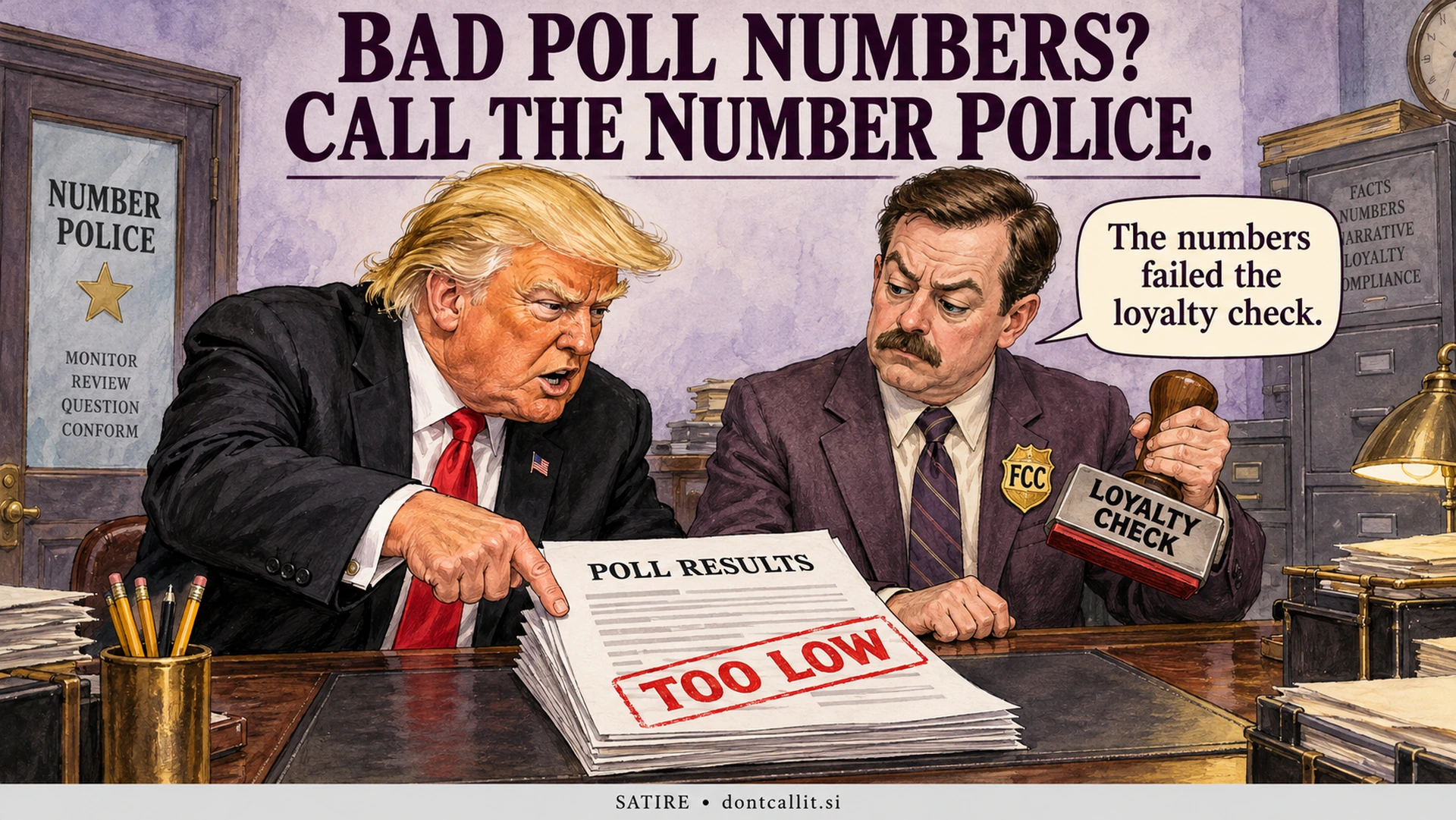
The real news is less whimsical: on October 21, FCC Chairman Brendan Carr warned broadcasters about allegedly fake or suppressive election polls, invoking news-distortion and broadcast-hoax rules.[2][3] He identified no specific polls. Reuters also reported Trump's pressure on Carr to act against broadcasters.[1]
That is Carr's warning, not an enacted ban on unfavorable numbers. Our Number Police exist in satire. Their desk, however, practically assembles itself.
"Where were you on the night the president expected better coverage?" the fictional interrogator asks the percentage.
The percentage requests a calculator.
This is taken as evidence of outside coordination.
Down the hall, a random sample is being searched for disloyalty. Officials are particularly suspicious of the randomness. Why, they ask, would a patriotic pollster contact people without first finding out whether they appreciate the president?
The sample explains that this would defeat the purpose. The officer writes down "admits purpose" and orders another filing cabinet.
In the next room, a margin of error is attempting to explain itself to a political appointee who has already decided that the only acceptable error is underestimating the applause. The phrase "statistical uncertainty" is flagged as defeatist.
The imaginary bureau's training manual contains a rigorous test. First, examine the methodology. Second, examine the sample. Third, if neither improves the president's mood, examine whether the pollster owns a television station.
Its evidence room is beautifully organized. There is a drawer for specific allegations, a drawer for supporting documents, and an entire empty cabinet reserved for examples that will be supplied just as soon as everyone has absorbed the warning.
Fabricated polling would deserve scrutiny. A disappointing result needs evidence before it becomes a fabrication. Otherwise, the investigation amounts to holding a thermometer accountable for the fever.
The bureau tries this anyway. By afternoon, the thermometer has been placed on administrative leave. The fever is praised for its tremendous energy.
The percentage, meanwhile, offers a practical suggestion: perhaps the president could do something that makes more people approve of him. Officers confer. The recommendation is rejected because it requires the president to change before the numbers do.
At closing time, the bureau announces its first major success. Every poll has been required to put the president first.
The pollsters agree. That was already the first question.
Key Takeaways
- Carr warned broadcasters about purportedly fake polls without naming an example.[1]
- The warning is not evidence that a particular unfavorable poll was fabricated.
- Criticism of polling should identify a methodological or evidentiary problem; disappointment alone does not supply one.
Frequently Asked Questions
Who issued the October 21 warning?
FCC Chairman Brendan Carr issued it on X. It should not be represented as a new order personally announced by Trump.[2][3]
Did Carr identify a specific poll in that statement?
No. The reporting reviewed for this article said he did not name one.[1]
Is an inaccurate poll necessarily deliberate news distortion?
No. As Reuters reported, Democratic FCC Commissioner Anna Gomez distinguished deliberate misrepresentation of something significant from a poll that simply proves incorrect. That distinction matters when assessing a particular allegation.[1]
Receipts
- Reuters, carried by KELO: FCC chair says broadcast networks could violate regulatory obligations by airing fake polls - October 21, 2026
- Brendan Carr's October 21 statement on X
- Bloomberg: FCC head warns broadcasters against airing fake polls - October 21, 2026
Related: Fake News. Real Bills. and the White House press-room bouncer.
Political satire. The bureau, interrogations, officials' dialogue, and Number Police are invented; the cartoon's bureaucrat is a fictional character.