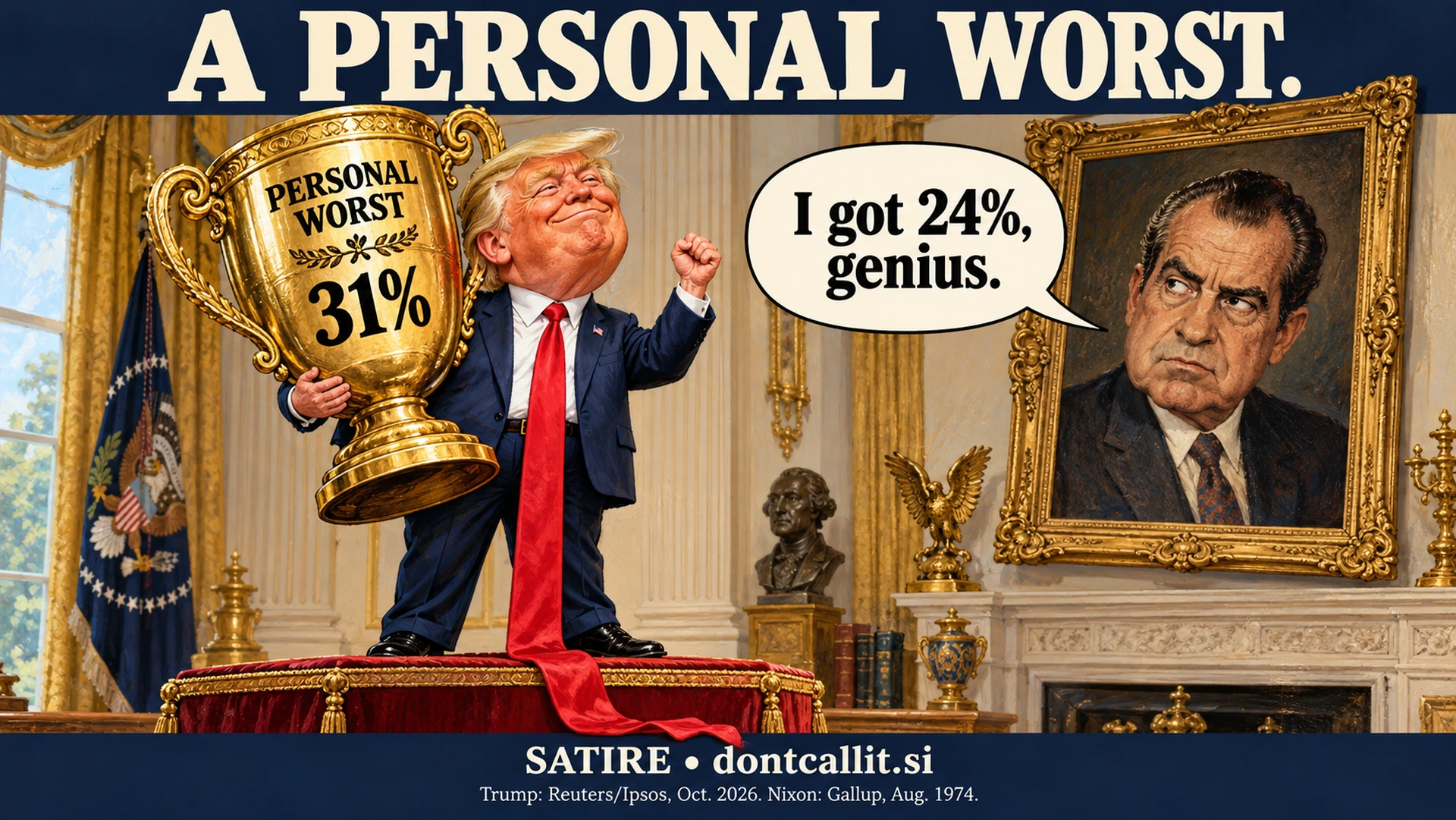
Donald Trump has reached 31% approval in the latest Reuters/Ipsos poll, which is a perfectly respectable number if you are advertising ice-cream flavors. As a review of your presidency, it suggests the customers would like to speak to somebody else. For a man who markets his personality as a national asset, this is a fairly emphatic recall notice. [1][2]
Key Takeaways
- Reuters/Ipsos found 31% approval and 66% disapproval in its October 16-19 survey. Reuters called it his lowest reading across both terms in that polling series. [1][2]
- It is above Nixon's 24% Gallup reading in August 1974 and Truman's 22% in 1952. The "lowest in presidential history" claim is wrong. [3]
- These are different surveys from different eras. They provide historical context, rather than a single continuous league table or an election prediction.
The historical record refuses to applaud
There is an awkward detail for anyone preparing the Biggest Loser in Presidential History sash: Tricky Dick still went lower. Gallup recorded Richard Nixon at 24% shortly before his Watergate resignation. Harry Truman reached 22%. Donald's 31% does not beat either number. [3]
This leaves Donald in an uncomfortable position. He has achieved a miserable result without securing exclusive naming rights to the misery. Even after applying a generous coat of gold leaf, 31 remains larger than 24. Somebody should check whether the mathematics department has been sufficiently loyal.
The comparison is embarrassing enough without improving it. When Richard Nixon becomes the historical reference point for your popularity, the communications team has already moved beyond choosing a flattering photograph. They are deciding whether the photograph needs a trapdoor.
A participation trophy with presidential security
Imagine getting 31% on a performance review and requiring the office to organize a celebration. The cake would arrive under heavy supervision. Your colleagues would spend the entire afternoon congratulating the baker.
Donald's great contribution to the awards business is the possibility of a trophy so large that nobody can see the result behind it. A normal manager receives difficult feedback and considers making changes. Our imaginary presidential awards committee considers a taller plinth, stronger lighting, and whether the word approval really needs to appear on the plaque.
There must be an extraordinary amount of work involved in treating every outcome as a personal triumph. Other people finish a bad meeting and go home. This operation needs a brass band, a revised definition of success, and somebody willing to announce that the room has never been this enthusiastic about the fire exit.
Two thumbs down for every thumbs up
The Reuters/Ipsos topline has 66% disapproving and 31% approving. That is more than two disapprovers for every approver in this survey. [1] A restaurant with that balance of customer satisfaction would at least investigate the soup.
The president, of course, has the advantage of being surrounded by people whose employment depends on looking delighted. The public has fewer professional obligations. A person answering a survey can express disappointment without first checking whether the next Cabinet meeting requires a handwritten thank-you note.
That is the difficulty with taking the applause outside the building. The people who were hired to clap have excellent attendance. The people who were supposed to benefit from all this keep insisting on discussing their experience.
We covered Donald's preferred approach to unwelcome numbers in Trump Calls Reality Fake. Reality Still Wants Its Money. This result presents a different practical problem: even a very large ego needs somewhere to put all the people who are unimpressed.
An exciting endorsement to explain at the door
For a nervous Republican candidate, presidential attention can start to resemble a relative announcing that he is coming to help with the wedding. You appreciate the thought. You would appreciate it even more if he stayed home and sent something useful from the registry.
In our imaginary campaign office, the presidential visit produces three departments: one arranging the stage, one locating the escape route, and one practicing a facial expression that conveys gratitude without suggesting responsibility. The photographer has been asked whether he can crop a handshake out of a handshake picture.
A bad approval poll does not decide an election. Candidates, turnout, and individual races still matter. It does, however, complicate the sales pitch when the famous endorser needs a lengthy explanation before anyone can discuss the person actually on the ballot.
Eventually, someone has to walk up a driveway and explain why more of this would be a terrific idea. Donald gets the music and the motorcade. The candidate gets a man in slippers asking about his heating bill.
The award for making it about himself
There is still something impressive about the scale of the self-confidence. Most of us can be unsettled by one disappointed email. Donald's political brand seems designed to withstand a national survey by requesting a better entrance song.
In a healthier performance review, success would mean more people thinking the job was being done well. In the imaginary ceremony Donald would prefer, success means everyone agreeing that the man receiving the disappointing review looks magnificent holding it.
Thirty-one percent approval is a serious political warning. Turning it into another occasion to admire the president would be an astonishing response.
Please stand for the presentation of the participation trophy. The public has already declined.
Questions worth asking
Is 31% the lowest presidential approval rating in history?
No. Gallup recorded Nixon at 24% in August 1974 and Truman at 22% in 1952. The Reuters/Ipsos result does not support that historical claim. Different pollsters and periods also require care when making comparisons. [3]
Is this Trump's lowest result in every poll?
No. Reuters described 31% as his lowest across both terms in its Reuters/Ipsos series. Pew recorded 29% near the end of his first term and reported 30% in its October 8, 2026, release. Always name the pollster. [2][4]
Who was surveyed, and when?
Ipsos surveyed 1,679 U.S. adults through KnowledgePanel from October 16-19, 2026. Its stated margin of sampling error for the full adult sample is plus or minus 2.4 percentage points. An approval poll measures opinion; it does not settle an election. [1]
Did Nixon really say the words in the cartoon?
No. The talking portrait, trophy ceremony, and dialogue are invented satire. The approval figures are separately sourced, and the Trump and Nixon numbers come from different pollsters and years.
Receipts
- Ipsos: Reuters/Ipsos mid-October survey, fieldwork and methodology. Official topline PDF, including approval results on page 4.
- Reuters, October 19, 2026: Trump approval falls to record low of 31% as midterms near.
- Gallup: Nixon's 24% approval in August 1974 and Truman's 22% in 1952.
- Pew Research Center, October 8, 2026: current approval and the 29% first-term low.
Political satire and opinion. Reporting checked October 21, 2026. Imagined ceremonies, campaign scenes, and dialogue are fictional.