An invented meeting of the Committee on Eventually Letting Go.
Washington has launched a bold initiative to recruit the next generation of leaders. Applicants should bring fresh ideas, a strong work ethic, and a photograph of what they looked like when they first applied.
The first applicant was 58. The committee asked whether his parents knew he was there.
"You're the future," the chairman assured him. "Wait outside."
"How long?"
"Until you're ready."
"That's what you told my father."
"Lovely man. Promising young fellow."
The applicant presented a plan to make housing affordable. Members admired the presentation but worried that fixing a problem would leave them without something to promise at the next election.
The chairman explained that leadership requires experience.
"I've spent forty years working on these problems."
"Yes," said the applicant. "That's on my list of concerns."
An aide reminded him that the chairman had won many elections. The applicant asked whether winning the job repeatedly was the same as doing it well.
The aide wrote HOSTILE TO DEMOCRACY on his application.
A consultant suggested mentoring younger candidates. Everyone loved this. It allowed them to support the next generation without giving that generation any authority, budget, or office space.
"What would I learn?" asked the applicant.
"How Washington works."
"And then I could change it?"
The consultant quietly retrieved his brochure.
The committee briefly considered retirement. A Republican enthusiastically supported it for Democrats. A Democrat enthusiastically supported it for Republicans. Within minutes, both parties had agreed that everyone else should make room for fresh ideas.
The applicant suggested a performance review. Perhaps members could explain what they had accomplished, answer unscripted questions, and demonstrate that they understood the decisions they were making.
"At your age," the chairman said, "you should know better than to ask things like that."
The application also asked candidates to describe their long-term goals. One woman wrote that she hoped to serve, accomplish something useful, and eventually leave.
Security was called. She was clearly planning to destabilize the institution.
To reassure the remaining applicants, the committee unveiled its succession policy. Every promising candidate would receive personal encouragement, a photograph with a senior member, and a reminder that now was a particularly dangerous time to try anything different.
The reminder would be renewed every election.
The 58-year-old asked whether the program had a graduation date.
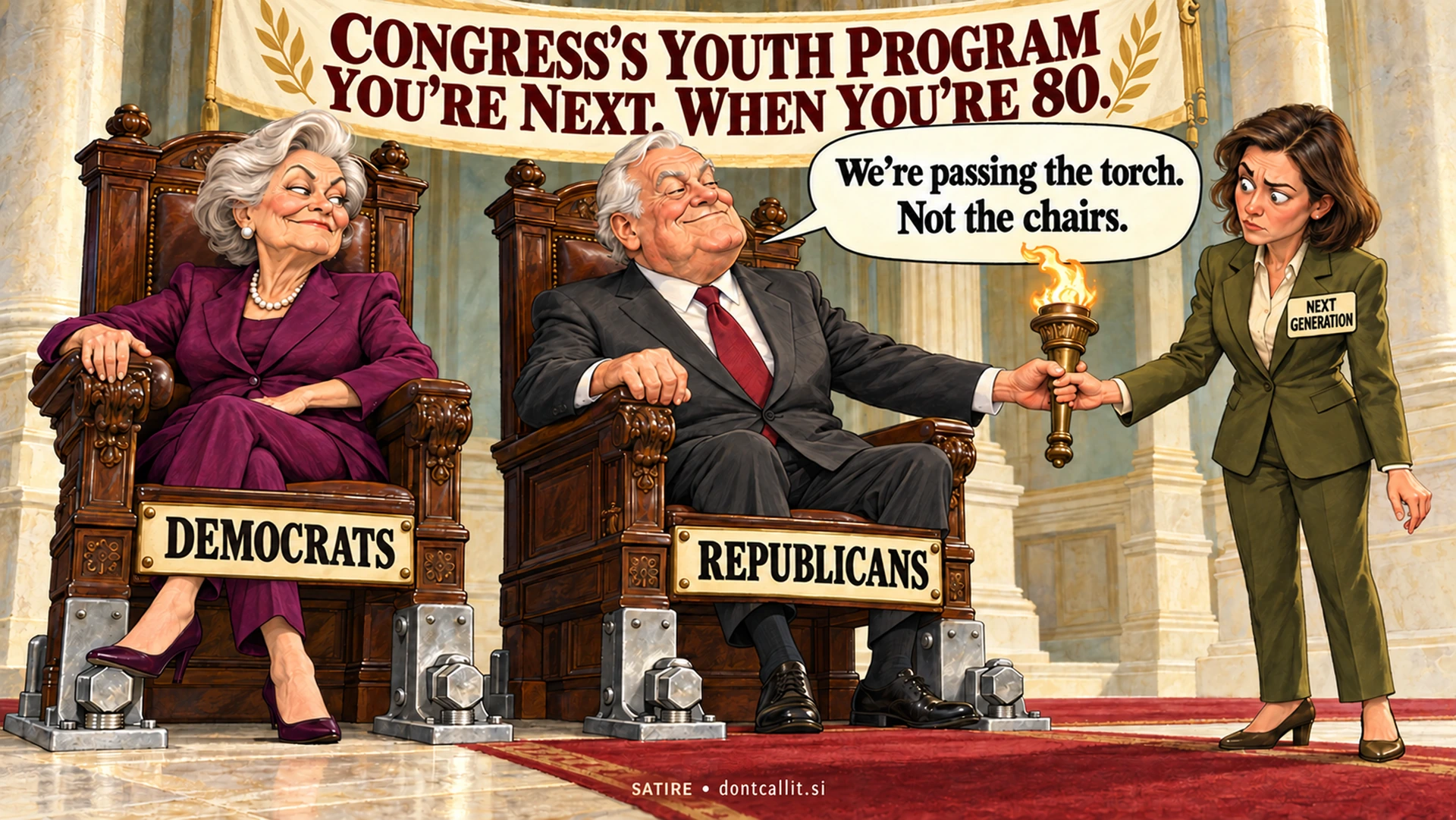
"We review candidates when they turn 80."
"For leadership?"
"For the youth wing."
The meeting ended with a fundraising dinner honoring the committee's commitment to tomorrow's leaders. Tomorrow's leaders were invited to clear the plates.
The applicant finally received a letter congratulating him on his potential. He could remain in the program for as long as he liked, provided he promised not to run against anyone currently supporting his development.
He asked whether there was at least a certificate.
There was. It said WAIT YOUR TURN.
The chairman signed it, then asked whether the young fellow would consider a recurring donation.
Key Takeaways
- Pew's January 3, 2025 snapshot put the House's median age at 57.5 and the Senate's at 64.7.[1]
- Both chambers were slightly younger than at the start of 2023.[1]
- The Constitution sets minimum ages of 25 for representatives and 30 for senators, with no maximum age specified.[2][3]
Frequently Asked Questions
How old were members of Congress at the start of 2025?
Pew reported median ages of 57.5 in the House and 64.7 in the Senate. These are January 2025 figures.[1]
Was the 119th Congress older than the previous Congress?
Its starting median ages were slightly lower: the House fell from 57.9 to 57.5, and the Senate from 65.3 to 64.7.[1]
Is there an upper age limit for serving in Congress?
The constitutional qualifications specify minimum ages of 25 for House members and 30 for senators. They do not specify a maximum age.[2][3]
How long are House and Senate terms?
House members serve two-year terms. Senators serve six-year terms, with approximately one-third of Senate seats coming up for election every two years.[2][3]
Receipts
- Pew Research Center's January 2025 age analysis
- U.S. House of Representatives: The House Explained
- U.S. Senate: Qualifications and Terms of Service
Related: Republicans found a spine. It came with an eraser. and Donald Declares America Smart. Evidence to Follow.
Political satire. The committee, interviews, youth program, correspondence, and dialogue are invented.