
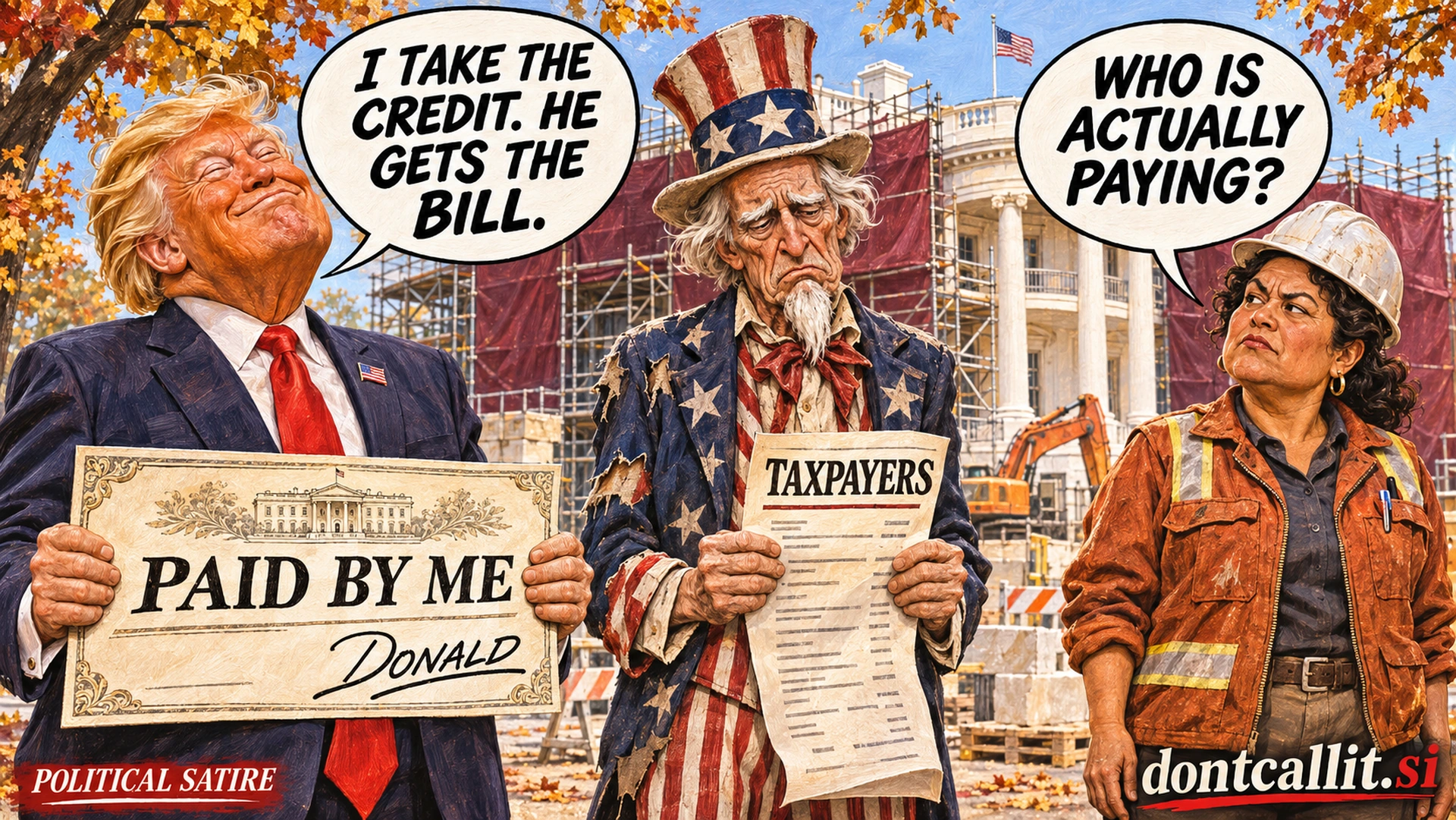
Political satire. The company, meeting, dialogue, and accounting arrangements below are invented. The factual FAQs are sourced separately.
Donald opened a construction company with one employee in accounting and fourteen in personal congratulations.
The accountant lasted until the first invoice.
"Who is paying for this?" she asked.
"I am," Donald said.
She placed it on his desk. He slid it back.
"Not like that."
By lunchtime, the company had adopted a more precise division of responsibilities. Donald would personally select the improvements, personally inspect the improvements, and personally explain why nobody else could have made the improvements.
Payment would be handled impersonally.
The new accounts manager was instructed to establish a private funding source. She asked for the account details. Donald gave her a television booking.
"That's not a funding source."
"It will be private until they ask."
The first contractor wanted a deposit. Donald offered a photograph of the two of them shaking hands. The contractor explained that his employees preferred money, a limitation Donald attributed to the unions.
An aide proposed a plaque recognizing the president's generosity.
"Can we afford it?" asked the accounts manager.
"We can't afford not to," said the aide. "People might see the building and think the people who built it built it."
The plaque was approved immediately. The invoice went to the Department of Things Donald Has Already Paid For, which had no relationship with Donald's bank.
At the weekly progress meeting, a project manager reported that the work was over budget.
Donald said that was impossible. He had spent almost nothing.
"The project is over budget, sir."
"Then speak to whoever is paying for it."
"You said you were."
"And I stand by that."
The accounts manager tried a diagram. One column showed the person making the announcements. Another showed the source of the money. Donald demanded to know why his name appeared only once.
She explained that this was the question.
He ordered a wider first column.
Eventually, the company found a financing partner called Somebody Else. Somebody Else had excellent credit, millions of involuntary members, and a complaints department that only accepted calls every two years.
The arrangement suited Donald perfectly. He could describe the work as a personal gift without experiencing the unpleasant financial consequences of giving one.
A junior employee asked whether the public should receive some credit if public money was involved.
Donald considered that reasonable. The public would be thanked for having him.
Then came the naming rights. A donor who actually contributed money wanted a room named after him. Donald explained that paying for a thing did not entitle you to put your name on it.
The room would be named after Donald.
The accounts manager asked whether that rule also applied to Donald. The meeting ended early so everyone could attend the unveiling of the Donald J. Trump Center for Answering That Later.
At the opening, Donald announced that the project had cost him practically nothing, which he offered as proof of his exceptional business ability.
The contractor had to admit the arrangement was impressive. Most customers at least waited until the bill arrived before explaining why it belonged to someone else.
The accounts manager finally found a form Donald was willing to sign.
It authorized him to receive all future compliments.
Payment terms: immediately.
Key Takeaways
- Personal credit is not proof of personal payment.
- Every project needs a clear explanation of its costs and funding.
- A public improvement can deserve scrutiny even when the person announcing it expects applause.
Factual FAQs
What did Trump actually say about paying for the renovations?
On November 16, he said, "This doesn't cost money. This is peanuts. And I pay for it." The remarks came during questions about White House construction and the airline disruption. Source: November 16 transcript.
What federal spending did the new reporting identify?
The Washington Post reported approximately $3 million for Lafayette Square brickwork, with the National Park Service expected to pay. Source: November 17 reporting.
How much time did Trump say the construction work took him?
He said overseeing the work took ten minutes a day and emphasized that he knew construction people. That is his account of his involvement, not an independent time audit. Source: November 16 transcript.
Does his statement establish that every project was personally funded?
No. The quoted exchange is not an itemized accounting. It does not establish the payer, amount, and funding source for every separate project. Those require project-specific records. Source: the full exchange; assessment by dontcallit.si Editorial.
Related satire
Donald's Pool Won't Hold Its Coating. His Vandal Story Holds Everything.