An imaginary campaign discovers a fundraising technique nobody wants to put on the invoice.
Political satire. The consultant, staff, office, phone calls, thank-you card, and dialogue below are invented. Fundraising figures are campaign-reported. The timing does not establish why every donor gave.
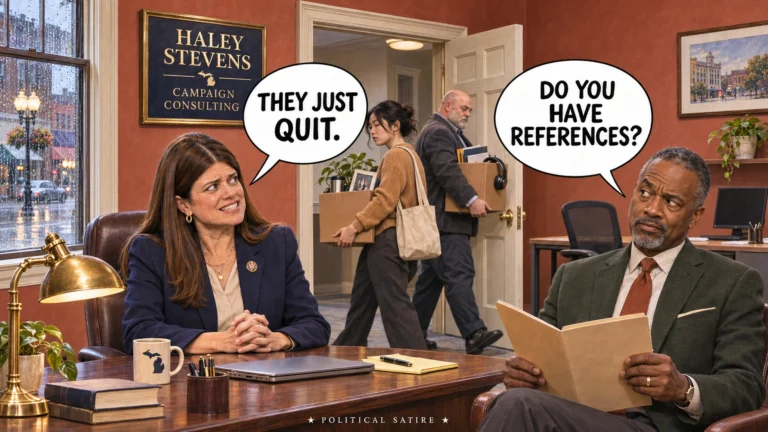
The campaign consultant arrived with a presentation called Building Momentum Through Strategic Partnerships. Before he reached slide two, the finance director asked whether he could explain the money.
"What money?"
"The money that arrived while you were preparing the presentation."
He checked his laptop. Several thousand people had apparently failed to wait for the strategy.
Please identify the person we should pay
In this imaginary office, the consultant's first task was to identify the successful message. He asked whether the campaign had released a new ad.
"No."
"A new policy?"
"No."
"A celebrity endorsement?"
The finance director hesitated.
"There was an endorsement."
"Excellent. Who endorsed us?"
"That's the part you're going to find professionally challenging."
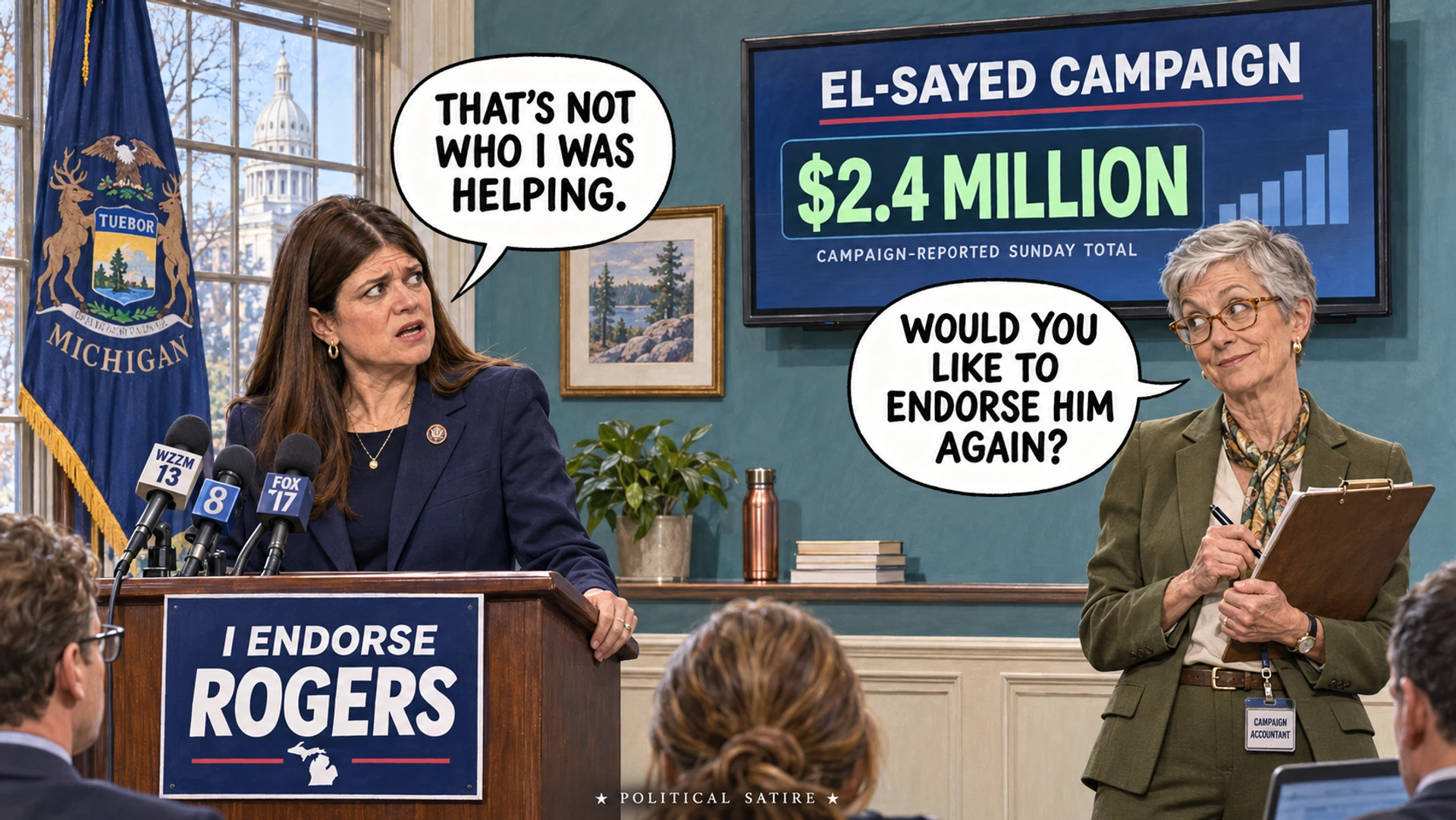
She explained that Haley Stevens had endorsed Mike Rogers. The consultant waited for the rest of the sentence to turn into something he could bill for.
It did not.
He wrote STRATEGIC DISAFFILIATION on the whiteboard and underlined it twice.
The enthusiasm is arriving from the wrong direction
A volunteer suggested that people might simply have opinions about what happened. The consultant said that was an interesting way to describe an emerging engagement channel.
The volunteer returned to answering phones. She had already learned that ordinary English was an unpaid position.
The consultant proposed a controlled experiment. Find another prominent person, have them endorse the opponent, and observe whether donations increased.
The campaign manager asked whether this would involve deliberately helping the opponent.
"Only at the message level."
"Where are elections conducted?"
He closed the spreadsheet for a moment.
Thank you for your opposition
The finance team drafted a polite acknowledgment. Nobody could agree on the recipient.
"We thank donors," the manager said. "That's the normal procedure."
The consultant wanted a separate category for people who had encouraged donors without intending to. He proposed Accidental Development Partner.
The lawyer asked whether anyone had agreed to become a partner.
"That's what makes it scalable."
A staffer tried writing the imaginary thank-you card anyway. She got as far as We appreciate your contribution before everyone agreed that contribution was doing far too much work.
They tried assistance. Then involvement. Then the entire card went into a drawer labeled LEGAL WOULD PREFER WE DIDN'T.
A difficult product to recommend
By afternoon, the consultant had packaged the episode into a service called Endorsement Inversion. The brochure promised to turn political rejection into measurable energy, subject to public reaction, news coverage, and literally everything else.
The campaign manager pointed out that the endorsement could still persuade people to vote for Rogers. Donations were not votes, and an election was not a dashboard.
The consultant nodded gravely. He added a second dashboard for votes.
The volunteer asked whether they could spend the remaining time talking to Michigan voters about their actual concerns.
"Absolutely," the manager said.
For the first time all day, a proposal was approved without a new name.
The invoice arrives
That evening, the consultant submitted his bill. Under Services Rendered, he had written Momentum.
The finance director asked what he had personally done.
"I recognized the opportunity."
"After the money arrived."
"That's when it became recognizable."
She returned the invoice with a note: We have decided to support another consultant.
He stared at it, then checked his phone.
"How soon should I expect the donations?"
Key Takeaways
- Haley Stevens endorsed Republican Mike Rogers on November 1 after losing the Democratic primary to Abdul El-Sayed.
- El-Sayed's campaign reported raising $2.4 million that Sunday, its largest single-day total.
- Fundraising is not an election result, and the total does not establish each donor's motivation.
Questions Worth Asking
Who did Stevens endorse?
Republican Senate nominee Mike Rogers. Reuters
Where does the $2.4 million figure come from?
El-Sayed's campaign supplied the figure for November 1. Washington Post
Was Stevens previously a rival of El-Sayed?
Yes. She lost to him in the Democratic Senate primary. Reuters
Does the fundraising total show who will win?
No. It describes campaign receipts, not ballots. Election Day is November 3. CNN election coverage
Original political satire by dontcallit.si Editorial.
Related satire: One Dan Sullivan Too Many. Deploy the Federal Government.