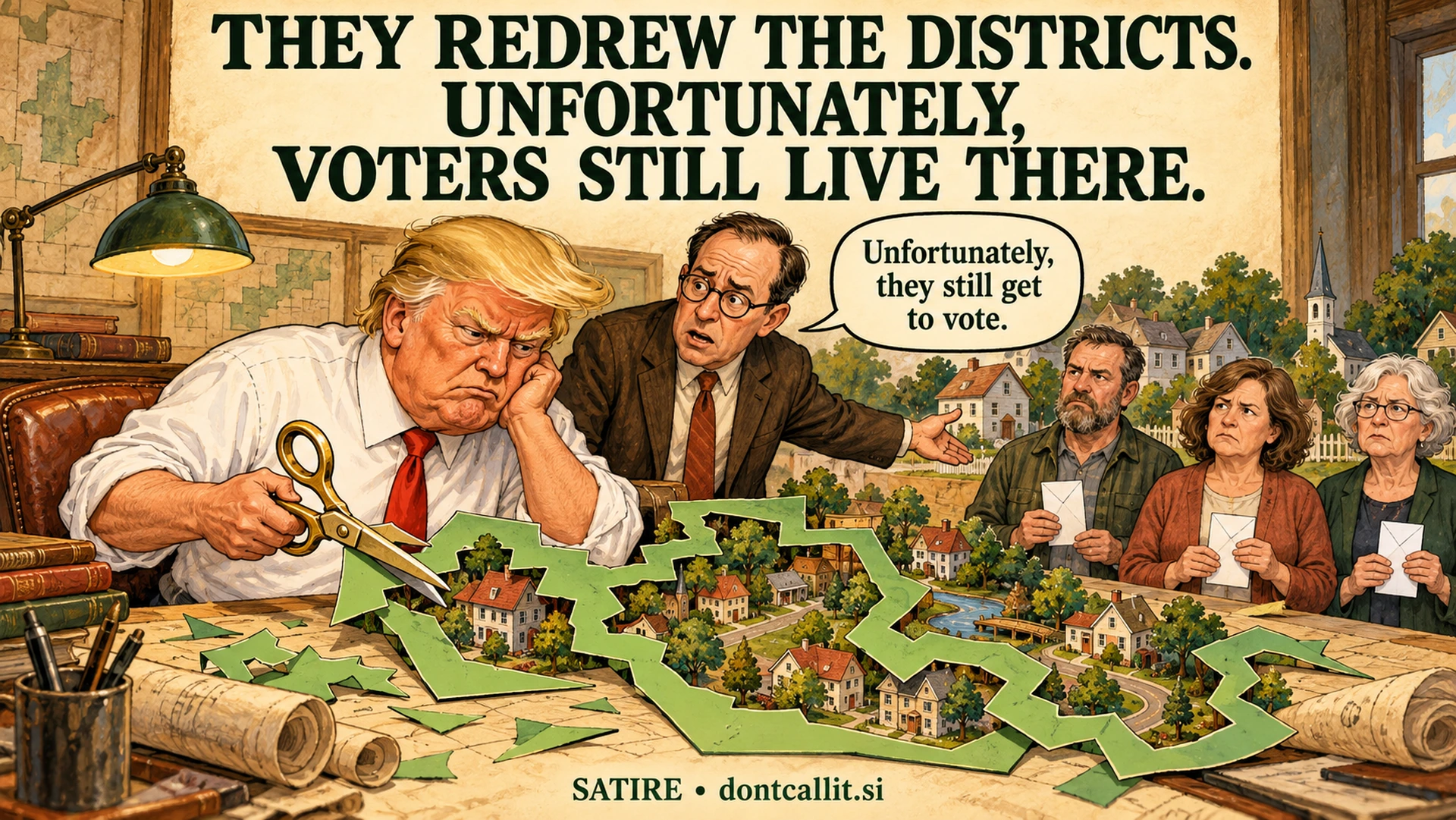
The Republican mapmaking department has encountered a serious design defect: every district comes with people in it.
The lines were supposed to do more of the campaigning. Bend here, stretch there, scoop up a helpful neighborhood, and democracy would arrive already assembled. Unfortunately, the residents kept watching the news.
A Reuters analysis published October 21 found that nine of 16 districts where Republicans had improved their advantage were now Democratic-leaning or too close to call; another had been thrown out by a court. The revised maps still favor Republicans overall more than the old ones did. These are pre-election assessments, not November results.[1]
In our imaginary Republican strategy meeting, this prompts an urgent technical review.
"We moved the boundary six miles," says the consultant. "Why aren't the people six miles happier?"
No one has an answer. The cartographer has delivered a district shaped like a dog trying to escape a bathtub. The pollster has delivered evidence that the dog would also like to discuss the president.
The team tries making the line thicker. Then thinner. Then gold. Someone suggests adding a tasteful flag. None of these changes alters the price concerns, political opinions, or television reception of the people living inside.
A junior aide asks whether the candidates should address those concerns. The room goes quiet. They have already paid for the map.
This is the problem with treating a representative district like a custom suit: you can keep taking it in, but eventually the person wearing it has to stop embarrassing everyone at dinner.
The fictional consultants propose a premium service. For an additional fee, they will redraw the district with the same voters in a more optimistic arrangement. The homeowner who disapproves of Trump will be placed next to a lake. The homeowner who strongly disapproves will be placed behind the lake, where the campaign cannot see her from the highway.
The next briefing is encouraging. The district now looks excellent from above. Its residents remain inconvenient at ground level.
One strategist asks whether there is any way to include the houses while excluding the conversations happening in them. Another recommends a ribbon cutting. A third asks whether the scissors have been tested on the president's approval problem.
None of this means partisan mapmaking has stopped mattering. It can create substantial advantages, and a competitive race can still end in a Republican win. But a favorable boundary is not a signed contract with the people inside it. A district cannot be instructed to appreciate the effort.
The imaginary meeting finally ends with a frank assessment: the map is beautiful, the strategy is expensive, and the candidate still has to persuade somebody.
For the next presentation, the consultants have prepared a bold new proposal.
They will turn the map upside down.
Key Takeaways
- Favorable boundaries can help a party without guaranteeing individual victories.
- The warning signs concern race ratings before voting is complete, not declared winners.[1]
- A campaign still has to contend with voters' views of its candidates and their performance.
Frequently Asked Questions
What is gerrymandering?
It is the drawing of electoral boundaries to advantage a party or group. A district's shape alone does not establish the purpose behind it.
Is a competitive district a district the Republicans have lost?
No. A competitive rating expresses uncertainty about an upcoming result. It does not award the seat to either party.
Can favorable maps and a difficult campaign exist at the same time?
Yes. Structural advantages do not remove the need to win votes. A party can benefit from its map while facing close races in some of the districts it hoped to secure.
Receipts
Related: Trump's approval-rating personal worst.
Political satire. The strategy meeting, consultants' proposals, and dialogue are invented. The reported analysis is linked above.