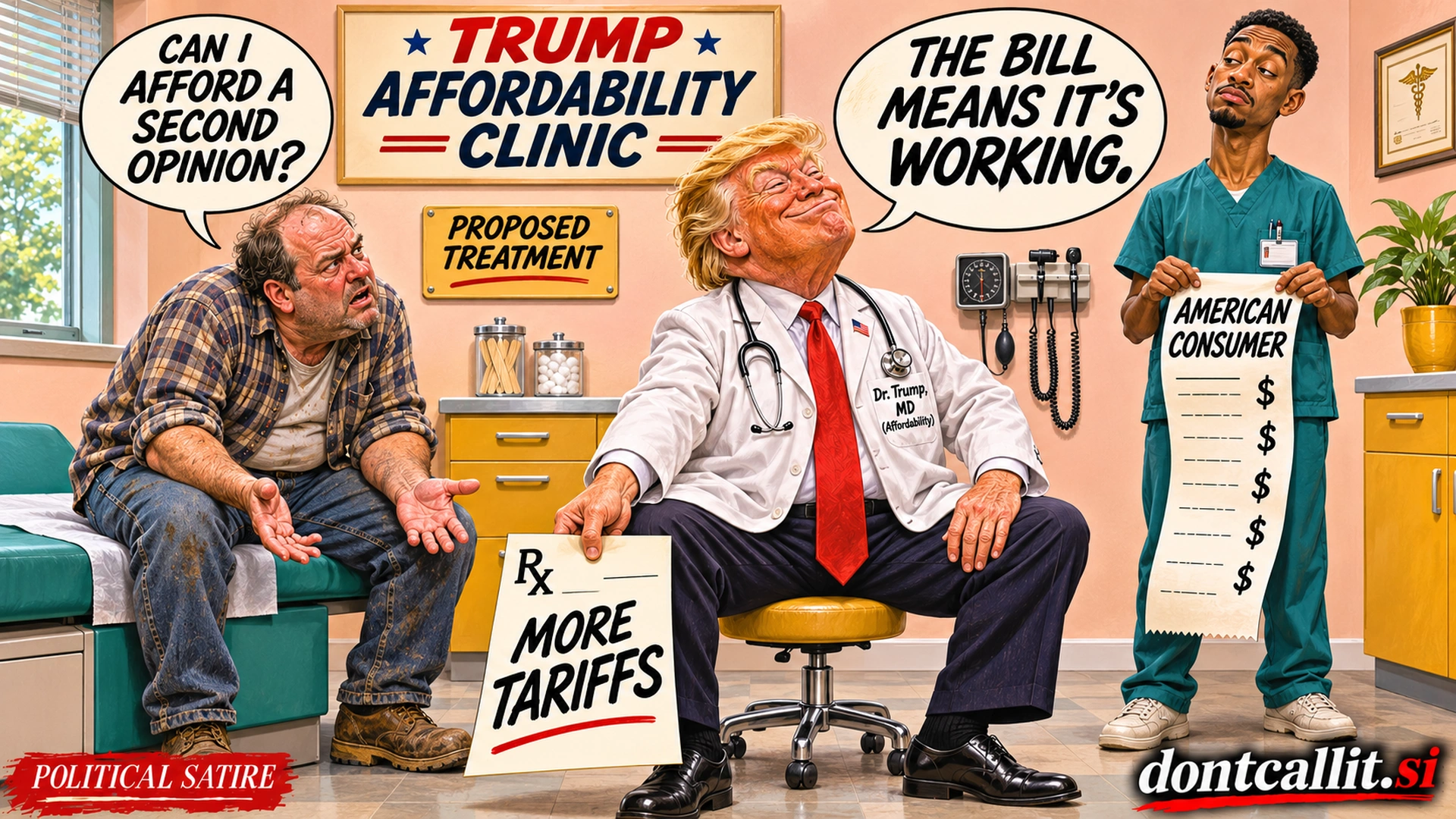
Political satire. The scenes, dialogue, and fictional programs below are invented.
Donald Trump has identified the problem with Americans struggling to pay their bills: the bills have not yet become large enough to qualify as a victory.
His new affordability program will address this by making imported goods more expensive until families develop the financial strength to stop buying them.
"People say they can't afford a refrigerator," Donald told his fictional economic team. "Very sad. Under my plan, they won't even afford the deposit. That's a much smaller refrigerator problem."
An adviser asked whether the administration might try reducing costs.
Donald stared at him with the concern normally reserved for someone who has just suggested putting a salad bar in a cement mixer.
"We already tried telling them costs were down. They kept bringing receipts."
The adviser was reassigned to the Department of Things Nobody Asked.
The foreign country at the checkout
At the first public consultation, a hardware store owner explained that a tariff bill arrives at his business, where he must decide whether to absorb the cost or increase prices.
"Incorrect," Donald said. "China pays."
The owner showed him the invoice.
Donald inspected it closely. "Your name is on this. Why did you put your name on China's bill?"
"Because I'm the importer."
"Well, that was your first mistake."
The owner asked how to become China before the next shipment arrived. The White House promised to look into it, provided he bought the gold membership.
A tremendous reduction in what you can buy
The administration's fictional Household Prosperity Office then unveiled a new measure of success: the number of unaffordable items Americans no longer waste time considering.
A washing machine crossed off the shopping list counted as a savings. A postponed business expansion counted as reduced workplace stress. A family abandoning its holiday plans counted as a successful investment in staying home.
One woman said she had already cut everything except essentials.
"Excellent," Donald said. "We're eliminating indecision."
She asked when the relief would begin.
"You're feeling it right now."
"That's nausea."
The office recorded her as feeling something strongly about the economy.
Please hold for your cheaper future
Officials assured the public that the next round would be different because it came with fresh paperwork. Previous tariffs had encountered legal trouble. These arrived wearing a different statutory hat.
A small manufacturer asked whether the new legal explanation would make imported components cheaper.
No, but the explanation was available as a free download.
He asked whether he could pay his suppliers with it.
The meeting ended early.
By evening, Donald had announced that the affordability crisis was nearly solved. Americans would soon be spending less because they would be buying less, owning less, and asking fewer questions in stores they could no longer afford to enter.
One reporter asked what happened if the public rejected the plan.
"We'll explain it again," Donald said.
"And if they still reject it?"
"Charge for the explanation."
Key Takeaways
- On November 25, the administration proposed tariff actions covering 14 trading partners, including China and the EU. These proposals are not newly effective duties today.
- The government says the measures address manufacturing overcapacity and unfair trade practices. Product exemptions, existing duties, and negotiated commitments affect the proposed rates.
- Importers owe U.S. customs duties. That payment obligation is different from how businesses, suppliers, and customers ultimately share the economic cost.
What actually happened
The U.S. Trade Representative announced the proposals under Section 301 after investigations into manufacturing overcapacity. Its stated purpose is to protect American production from foreign policies it considers unfair. Written comments are due January 5, 2027, with hearings starting January 25. The satire above does not describe an actual Trump speech or program.
Sources: USTR's November 25 announcement, Reuters reporting.
Factual FAQs
Did these tariffs take effect on November 25?
No. USTR proposed actions for public comment and hearings. The announcement did not put the proposed duties into effect that day. Source: USTR.
Is every proposed tariff simply added to all existing tariffs?
No. The calculations differ by trading partner and product. USTR specifies offsets for certain existing duties and exemptions, so a headline rate is not automatically an additional charge on every import. Source: USTR.
Who pays the tariff to U.S. Customs?
The importer is legally responsible for the customs duty, either paying directly or through an agent. That does not establish how much of the cost ultimately falls on customers or other businesses. Source: 19 CFR 141.1.
What is the administration's reason for proposing them?
USTR says foreign policies sustain manufacturing capacity beyond market demand and harm U.S. commerce. That is the agency's stated rationale, not proof that every proposed measure will achieve its intended result. Source: USTR.