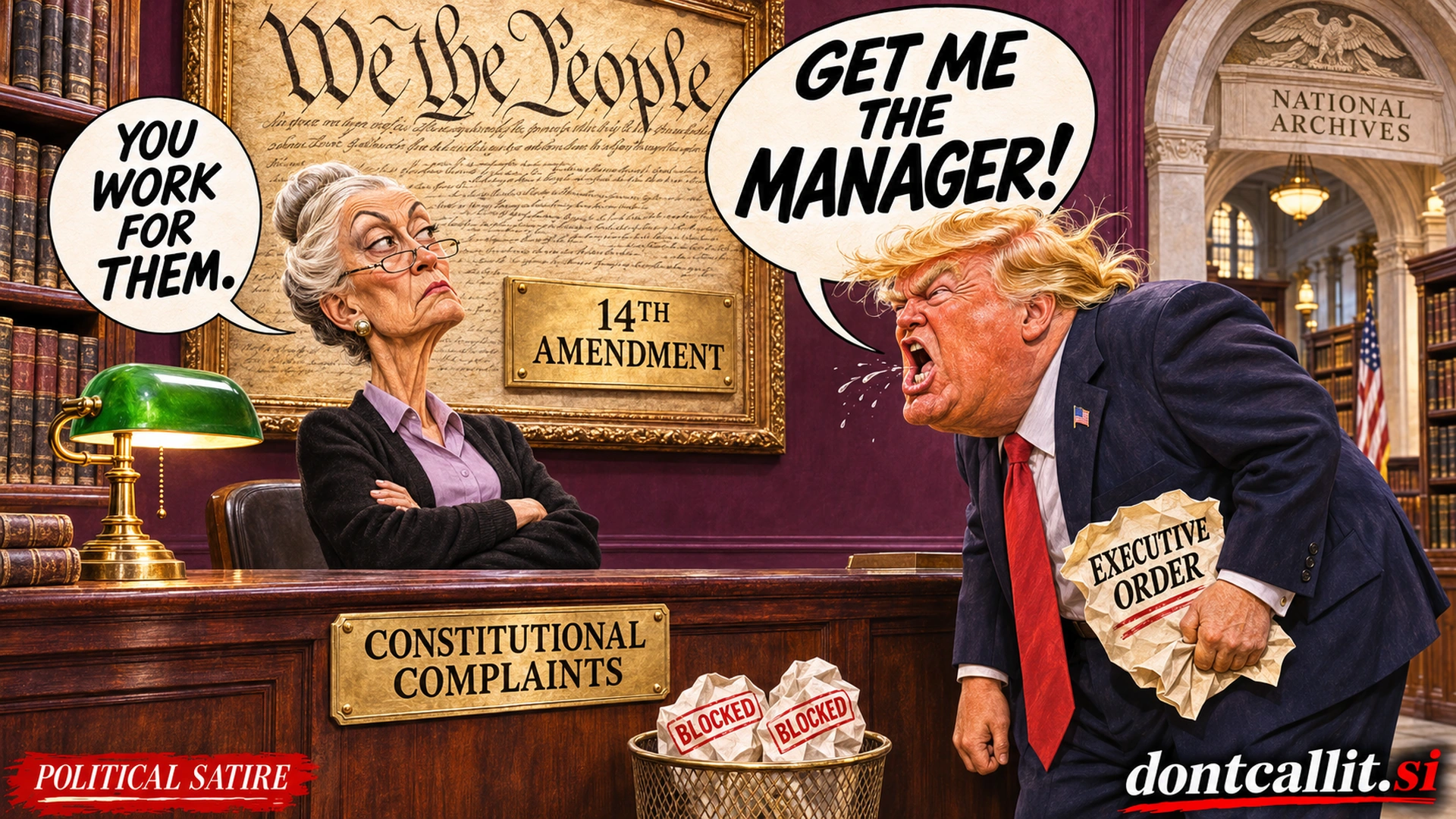
Political satire. The scenes and dialogue below are invented.
Donald Trump has filed a formal complaint against the Constitution after discovering that signing something with a very large pen does not automatically make it legal.
The complaint describes the document as old, poorly managed, and increasingly hostile to its most important customer.
"I signed the order," Donald told his fictional legal team. "There were cameras. I held it up. What part of that process remains unclear?"
An attorney explained that the Constitution limits presidential power.
Donald asked why nobody had mentioned that during the inauguration.
"It was the thing you swore to preserve, protect, and defend."
"I say a lot of things at events."
Have you tried signing it harder?
After another court blocked his attempt to restrict birthright citizenship, Donald demanded a review of the administration's signing procedure.
Staff confirmed that the pen had worked. The ink had dried. The signature was visible from a passing aircraft.
Unfortunately, the Fourteenth Amendment remained underneath it in the legal hierarchy.
"Then get a thicker pen."
Stephen Miller proposed changing the order's title. The lawyers explained that judges read beyond the title.
Miller went quiet. That had not been included in the threat assessment.
An intern suggested reading the amendment before writing another order. His visitor badge stopped working before he finished the sentence.
The complaint department
Donald next instructed staff to locate whoever was responsible for the Fourteenth Amendment.
They explained that it was ratified in 1868.
"So they've been getting away with this for a long time."
He wanted its appointment records, political donations, and any photographs of it standing near Barack Obama.
An aide said the amendment had survived presidents from both parties.
Donald immediately accused it of playing both sides.
The White House then drafted a statement expressing concern about an unelected sentence that had never won a primary and apparently believed it could tell the president what to do.
The sentence declined to respond. It had already put its position in writing.
Citizenship, pending Donald
The fictional replacement proposal would require newborns to establish their eligibility by submitting a birth certificate, two character references, and a brief explanation of why the president should like them.
One lawyer asked how a newborn could obtain character references.
"Their father knows people," Donald said.
"What if he doesn't?"
Donald looked genuinely puzzled. "Then why did they hire him as the father?"
Miller suggested an interview. The legal team noted that babies cannot answer questions.
Donald brightened. Finally, applicants who understood how a White House press conference was supposed to work.
Please stop replying with the law
By late afternoon, the complaints team had produced a second copy of the first complaint, this time with IMPORTANT at the top.
It received the same answer.
Donald demanded an escalation, a different judge, and a version of the Constitution with a customer satisfaction guarantee.
His lawyers explained that the problem was the substance of the order.
"You've said that twice," he snapped. "Try saying something that helps."
An aide finally brought him a pocket Constitution.
Donald examined it, scowled, and handed it back.
"This one's smaller. See if it has less authority."
Key Takeaways
- Judge Christopher Cooper issued a classwide preliminary injunction on November 25 against Trump's second birthright citizenship order. The litigation continues.
- The opinion says the president cannot create new citizenship exceptions for U.S.-born children subject to American law.
- The dispute concerns constitutional citizenship protections, not a presidential application or approval process. The scenes above are invented satire.
What actually happened
In Nathan v. Trump, Cooper certified a class and temporarily blocked enforcement of Executive Order 14418 against its members. His opinion relies on the Supreme Court's June decision rejecting Trump's earlier order. Reuters reports that a Maryland judge also blocked the revised order in September. The White House disputes the latest ruling and maintains that its order follows the Supreme Court's analysis.
Sources: Court opinion, November 25, Reuters, National Archives: Fourteenth Amendment.
Factual FAQs
What did the court decide on November 25?
Cooper certified a class of affected children and issued a preliminary injunction preventing enforcement of the second order against that class. This was interim relief, not a final judgment ending the lawsuit. Source: opinion, pages 1-2 and 67.
What does the Citizenship Clause say?
Section 1 of the Fourteenth Amendment makes people born or naturalized in the United States, and subject to its jurisdiction, citizens. The jurisdiction qualification matters; the rule is not literally without exceptions. Source: National Archives.
Which children did the revised order target?
The opinion identifies groups including children of certain foreign government or international organization employees without diplomatic immunity, children born through commercial surrogacy, and children whose parents are suspected of membership in certain gangs or terrorist organizations. Source: opinion, page 2.
Why did the judge reject the government's position?
Cooper concluded that the Supreme Court's earlier decision foreclosed the president's attempt to create additional exceptions for children born here and subject to U.S. law. The administration disagrees with that conclusion. Sources: court opinion, Reuters.
Related satire
Donald Announces Prices Will Improve Once Everything Costs More